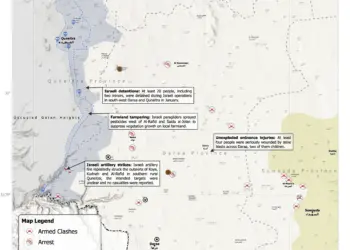
Israel is stepping up is provocative activities in south-west Syria: November saw an increase in cross-border ground incursions and raids into Quneitra and Daraa. Even more concerning, Israeli Prime Minister Benjamin Netanyahu led a high-ranking Israeli delegation tour through the “buffer zone” between the occupied Golan Heights and Syria. With talks between Damascus and Tel Aviv reportedly at an impasse, Syria may accelerate a once-unimaginable security relationship with Russia to counterbalance the rising threat from Israel.
Israeli Operations
Following a reported impasse in diplomatic talks between Tel Aviv and Damascus, Israel stepped up incursions into south-west Syria. More notably, Prime Minister Benjamin Netanyahu made a widely publicized and controversial visit inside Syrian territory occupied by Israel since December 2024, accompanied by a startling contingent of high-ranking Israeli officials that included Defense Minister Israel Katz, Foreign Affairs Minister Gideon Sa’ar, IDF Chief-of-Staff Eyal Zamir, Shin Bet chief David Zini, acting National Security Council Director Gil Reich, Israeli Ambassador to the US Yechiel Leiter and IDF Northern Command chief Rafi Milo. While not his first visit to newly occupied areas of south Syria, Netanyahu travelled deeper into Syrian territory than previous trips, marking his first documented visit to Israeli army positions in northern Quneitra.
Throughout the month, Israeli forces intensified the number of cross-border ground incursions, widespread searches of homes and patrols across Quneitra and south-west Daraa. In late November, the frequency of incursions intensified further across both provinces. While most searches and raids ended without arrests, Israeli forces detained dozens of individuals in recent weeks, including at least three individuals suspected of attempting to smuggle weapons into the occupied Golan. Israeli forces have also continued to prevent farmers from accessing their fields in parts of Quneitra, firing shots and even artillery at people nearby attempting to cross through the area.
A dawn raid by Israeli forces on 28th November in the Rural Damascus town of Beit Jinn kickstarted heavy clashes with local militants. Preliminary reports indicate that the patrol was ambushed inside Beit Jinn, before heavy clashes broke out. Israel responded with aerial bombardments using helicopters and UAVs as well as shelling, and later announced that six soldiers were injured. The death toll on the Syrian side reached 13 (including six local militants), with more than 25 wounded. The episode marks the first major armed clash with Israeli forces in the south-west since Israel occupied additional areas of Syrian territory in response to Bashar al-Assad’s ouster.
Political & Humanitarian Developments
Russian and Syrian defense officials took part in a joint tour of southern Syria in late November, raising speculation that Russian forces will return to the region. The publicized tour came after Damascus-Tel Aviv talks stalled and after nearly a year of increased Israeli military incursions in the south. The threat from Israel appears to have prompted a stark turnaround from Damascus, which now likely sees Moscow as a potential counterweight to Israeli expansionism. (Despite Russia’s well-documented crimes against the Syrian people in support of Assad, interim authorities have not dropped the old regime’s ally—midway through the November 2024 offensive, interim president Ahmad al-Sharaa opened a direct channel of communications with the Russians.)
More locally, the frequency of street demonstrations has increased in step with deteriorating socio-economic conditions in the region. Shop owners in Daraa city protested rent increases while teachers in the provincial capital demonstrated over salary cuts. The surging costs of telecommunications has become a growing source of anger, with an estimated 25 percent of average salaries now going to cover basic utilities and internet. In mid-November, protests were called at the Daraa offices of telecom companies SyriaTel and MTN over rising tariffs.
Instability in South-West Syria
Assassinations and kidnappings are returning to the south Syrian landscape: at least 13 individuals were assassinated across Daraa and Quneitra in November, in addition to numerous attempted killings. Kidnappings, meanwhile, are used primarily as a tool of intimidation, leverage, and extortion.
Following a wave of recent diplomatic engagements from regional states pushing for interim authorities to step up counter-smuggling efforts, as well as some security operations against smuggling networks, prices for Captagon have spiked over the past few months. Internal Security forces increased surveillance and counter-narcotics operations across eastern and northern Daraa, as well as in the adjacent Al-Lajat region. Narcotics seizures took place at the Nassib border crossing.