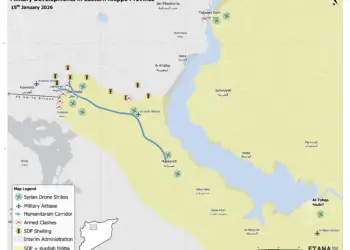
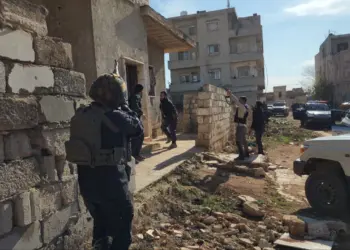
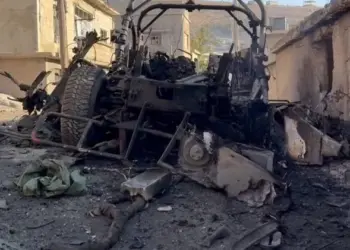
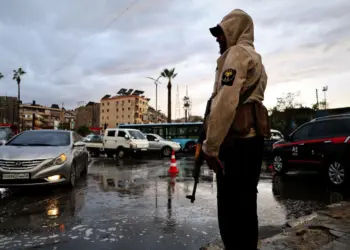
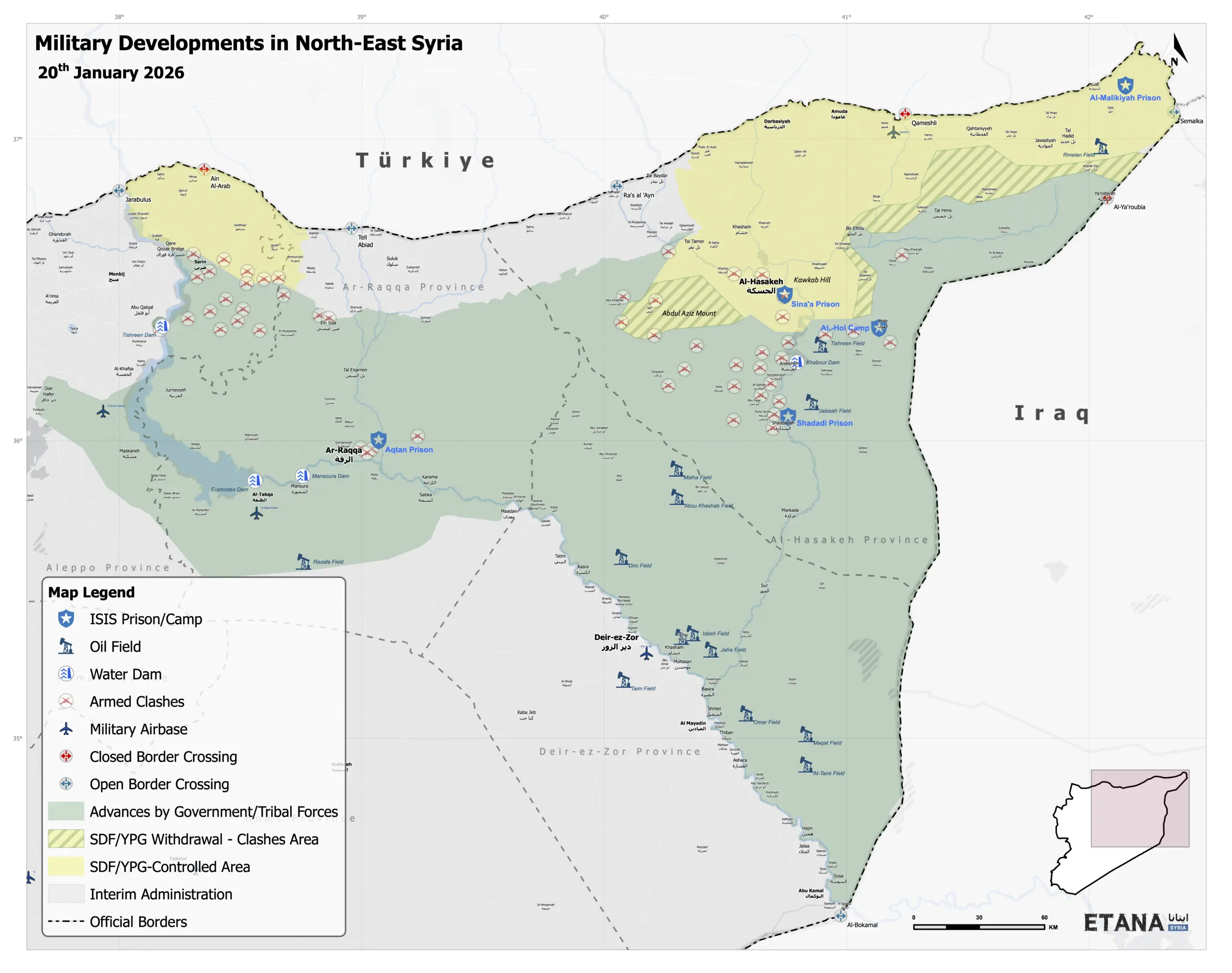
After launching a military operation on the Syrian Democratic Forces’ (SDF) last foothold in eastern Aleppo’s Deir Hafer late last week, interim authorities waged a broader push on the SDF-controlled north-east over the weekend. At the time of writing, pro-government forces affiliated with Damascus have seized control of most formerly SDF-held territory: only parts of Hasakeh and north-east Aleppo province remain. On Tuesday evening local time, the interim Ministry of Defense instructed its troops to observe a ceasefire during a four-day consultation period given to SDF commander-in-chief Mazloum Abdi to decide the fate of Kurdish-majority areas in north-east Syria. However, mutual trust between the two sides is at an all-time low, and the possibility for further violence in Kobane/Ain al-Arab and Hasakeh remains high. On-the-ground developments in north-east Syria are moving quickly rendering the situation difficult to predict.
Background
The interim Ministry of Defense announced late on Friday, 16th January, an operation to seize Deir Hafer and Maskana, part of the SDF’s last foothold in eastern Aleppo. Less than 24 hours later, the Syrian army regained control of both areas and subsequently expanded the operation towards Raqqa, in western Raqqa province, and other areas of the SDF-controlled north-east. Despite its pre-2026 fighting force of several thousand fighters, the SDF has been significantly weakened by defections and prominent northeastern tribes expressing support for interim authorities—both of which eased pro-government advances on the ground.
Pro-government forces, including Ministry of Defense and Internal Security units as well as tribal militias, launched their offensive on 17th January via two axes: Raqqa and Deir Ezzor. By the end of Saturday, the entire Al-Shamiyeh region of western Raqqa had been captured. Pro-government forces started entering Raqqa city the following day. In Deir Ezzor, the fighting was initiated by tribal forces attacking remaining SDF checkpoints and positions in eastern Deir Ezzor. Increasing numbers of Arab SDF fighters fled positions in the area, either hiding in their villages or crossing the river towards government-controlled areas. Clashes were reported in Abu Hammam, Abu Hardoub, Dhiban and Al-Jardhi.
Arab tribes played a crucial role in the territorial collapse of the SDF—particularly in Deir Ezzor, where Arab tribes have long resisted SDF attempts at control and co-option. Late on Sunday, tribal fighters—including recent Arab SDF defectors—in Al-Shuhail and Dhiban began seizing SDF military posts and raising the revolutionary flag over them, even before pro-government forces reached the area. Later in the night, Al-Baqqara tribal sheikh Hajim al-Bashir pledged his support for interim authorities; after this point, a similar pattern was repeated in Al-Baqqara tribal areas. This pattern of defections and shifting tribal allegiances made it possible for pro-government forces to quickly advance northward from Deir Ezzor towards Hasakeh. The SDF’s ranks were further weakened by defections by senior personnel, including Raqqa Civil Council chief (and former co-chair of the Self Administration’s Executive Council) Mashlab al-Turkan and Muhammad Ramadan al-Musleh, a prominent leader within the Deir Ezzor Military Council.
With pro-government forces gaining significant ground since the weekend, attacking forces quickly advanced on the southern countryside of Hasakeh. With the exception of Al-Shaddadeh, where there were reports of some clashes, much of Hasakeh’s southern countryside fell quickly.
First Ceasefire Agreement
On Sunday, 18th January, interim President Ahmad al-Shara’a and SDF chief Mazloum Abdi agreed to a 14-point ceasefire meant to end fighting in north-east Syria and integrate SDF commanders/personnel and Self Administration political institutions into interim government structures. Crucially, this agreement formalized the “full and immediate administrative and military handover of Deir Ezzor and Raqqa governorates to the Syrian government,” while outlining the “individual” integration of SDF military and security personnel into the interim Ministries of Defense and Interior. Although the text of the agreement resolved, on paper at least, several longstanding issues related to the Kurdish-administered north-east—including ISIS prisons, Kurdish cultural and linguistic rights as well as the civil status of unregistered/stateless Kurds—potential sticking-points remained, including the stipulated—but thorny—removal of all non-Syrian Kurdistan Workers’ Party (PKK) members from north-east Syria. The ceasefire therefore formalized new on-the-ground realities while also creating further grounds for continued conflict.
Current Military & Security Dynamics
Despite the ceasefire announcement, and the widespread buy-in from international interlocutors, fighting soon broke out again. With Raqqa and Deir Ezzor essentially secured, the fighting shifted to Hasakeh. By late Monday, 20th January, pro-government forces had reached within 10km of Hasakeh city’s southern entrance; as of Tuesday afternoon, 21st January, pro-government forces were within 5km of the city.
The fate of northeastern prisons containing ISIS prisoners has been the subject of claim and counter-claim in recent days, with both sides using the topic for political gain. Since fighting intensified in the north-east over the weekend, the SDF reportedly transferred some ISIS prisoners towards facilities further north. There have been reports of ISIS detainees escaping facilities during the chaos of the SDF’s collapse, although ETANA has been unable to independently verify the exact locations and numbers involved or the circumstances of reported escapes.
Speaking to Kurdish news agency Hawar on Tuesday evening prior to the second ceasefire agreement, SDF chief Mazloum Abdi saluted “resistance…in all areas subjected to brutal attacks,” before clarifying that the SDF had “withdrawn to predominantly Kurdish areas,” protection of which will constitute a “red line that we will not hesitate to defend.”
Second Ceasefire Agreement
Late on Tuesday, the interim Ministry of Defense instructed its troops to observe a ceasefire—starting at 20:00 local time—during a four-day consultation period given to SDF chief Abdi to decide the fate of Kurdish-majority areas in north-east Syria. Syria’s interim presidency stated that the four-day ceasefire period is intended for the SDF to develop a “detailed plan” for practical integration of remaining SDF-held areas and the political and military actors within them. The SDF has stated its “full commitment” to the ceasefire, adding that its forces “will not initiate any military action unless our forces are subjected to attacks in the future.” With mutual trust at an all-time low and front-line tensions high, there is still the possibility of renewed hostilities in spite of the stipulated four-day ceasefire period.
US envoy Thomas Barrack issued a statement on Tuesday providing the clearest indication yet of the White House’s position on recent developments in Aleppo and the north-east. He stated that the “original purpose of the SDF as the primary anti-ISIS force on the ground has largely ended” and that Damascus is both “willing and able” to take over security responsibilities in the north-east. Barrack’s statement also indicated that the US has no interest in a long-term military presence in Syria, hinting at the withdrawal of US forces at a later date.