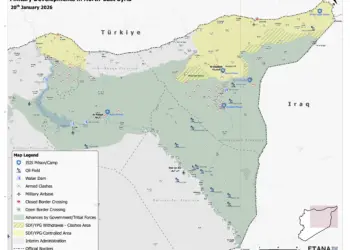
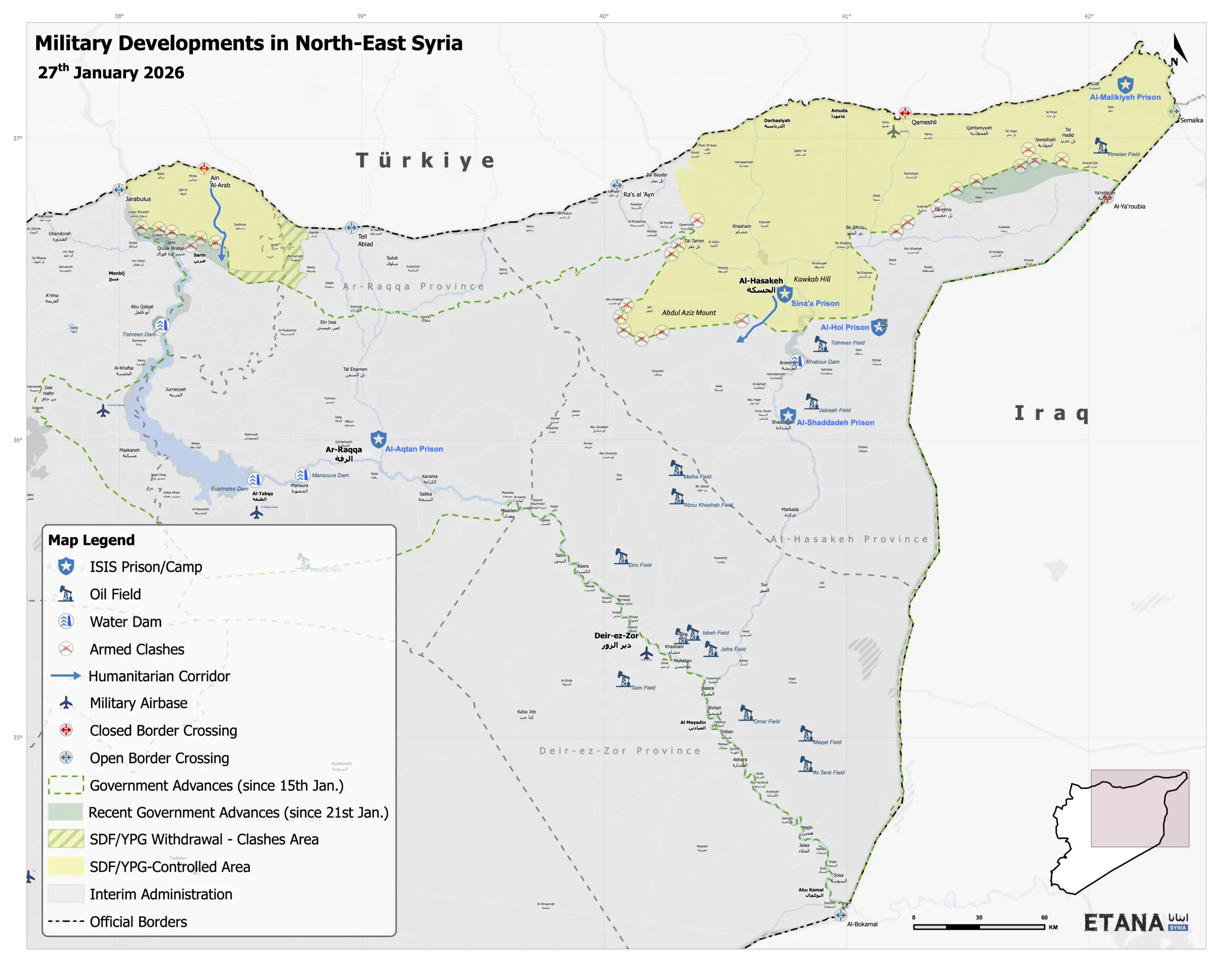
An additional 15-day ceasefire was announced in north-east Syria on Saturday. Although there were rumors of a possible breakthrough late on 27th January—with a plan floated that would see Internal Security units enter Kobane and Hasakeh before a mechanism was established to integrate Syrian Democratic Forces (SDF) fighters into interim security forces—the first days of the truce saw scattered fighting. With tensions high in the north-east, ongoing negotiations will determine next steps.
Background
Late on 20th January, the interim Ministry of Defense instructed its troops to observe a four-day ceasefire—starting at 20:00 Syria time on the same day—during which time the Syrian Democratic Forces (SDF) were expected to provide a “detailed plan” outlining the practical integration of remaining SDF-held areas and the political and military actors within them. The SDF at the time stated its “full commitment” to the ceasefire, adding that its forces would “not initiate any military action unless our forces are subjected to attacks in the future.”
In the run-up to the ceasefire announcement, pro-government forces seized several key areas, taking control of Al-Hol town and camp and Al-Yaroubiyeh and its surrounding countryside on 20th January. Tribal forces also began taking control of Tal Burak, between Hasakeh city and Qamishli, that same afternoon. Once the ceasefire came into effect Tuesday evening, military operations largely ceased along frontlines. In one exception, pro-government forces in the former Operation Peace Spring zone conducted an intense artillery bombardment targeting SDF forces near Tal Tamr.
Ceasefire Developments
The four-day truce across the north-east held, with frontlines remaining largely stable through 24th January. In and around Hasakeh province, both sides utilized the ceasefire period to bolster their front-line forces, possibly in anticipation of renewed hostilities or to shore-up their respective negotiating positions. Aircraft believed to be Turkish bombed two SDF positions in Qamishli city on Wednesday. Local media reported that one of the strikes targeted Sipan Hamo, a commander in the People’s Protection Units (YPG), but ETANA was unable to independently verify these reports.
With the onset of the ceasefire, troops from the US-led International Coalition began a series of extractions of ISIS detainees from formerly SDF-run detention facilities. It’s likely that the four-day truce was contingent on Coalition forces completing extractions before fighting resumed.
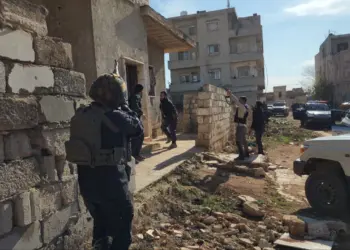
Dozens of SDF fighters holed up in the Al-Aqtan prison relinquished control of the facility, evacuating to Kobane/Ain al-Arab starting on 23rd January. The prison is now fully under the control of interim military police. State TV reported that 126 minors were released from the prison, having been previously detained by the SDF. One minor interviewed by SANA said they were tortured with electricity; videos of this interview were shared widely across social media over the weekend, with pro-government Syrians pointing to it as evidence of the SDF’s lack of legitimacy. Other prisoners’ files are currently under review by Syrian Attorney General Hassan al-Turba and Raqqa’s chief prosecutor.
On the political side, Massoud Barzani, head of the Kurdistan Democratic Party (KDP) in the Kurdistan Region of Iraq (KRI), is playing an increased role in mediatory discussions between the US and SDF, either as a partner to the SDF or as an independent mediator, speaking with US envoy Thomas Barrack on Monday and hosting a meeting between Barrack and SDF chief Mazloum Abdi in Erbil last week.
Russian forces stationed at Qamishli International Airport evacuated personnel, equipment and supplies by cargo plane, likely in anticipation of renewed fighting in the region that could see pro-government forces advance on more northerly areas of Hasakeh province. Reuters reports that military vehicles and heavy weaponry there have been transported to the Russian base at Hmeimim, on Syria’s coast.
Current Military & Political Dynamics
One stipulation of the four-day truce was that the SDF’s leadership would provide a “detailed plan” for integration of its forces under the interim Ministries of Defense and Interior. SDF chief Mazloum Abdi stated that “according to the agreement, government forces will not enter Kurdish cities, but our institutions will be integrated [within] government institutions,” adding that the SDF had submitted proposals for assistant minister of defense and Hasakeh governor—two positions that previous negotiations slated for Kurdish, ex-SDF figures—however, there was “no agreed-upon list yet.”
Despite these flexible statements from Abdi, there still appear to be divisions within the SDF’s leadership on next steps: Women’s Protection Units (YPJ) commander Rohlat Afrin said “we do not accept” individual integrations into the interim Ministry of Defense, adding: “The Kurds must have a force to protect Rojava, and we are currently trying to impose this on them.”
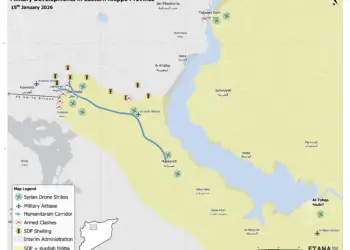
Meanwhile, interim authorities announced Sunday the opening of two “humanitarian corridors” for civilians to leave the last two SDF-held enclaves: the first runs south-west from Hasakeh city towards Raqqa; the second runs from Kobane/Ain al-Arab, via Tal al-Ghazal, towards Nour Ali. Similar announcements foreshadowed escalations in both Sheikh Maqsoud/Al-Ashrafiyeh and Deir Hafer earlier in January.
Starting on Sunday morning, clashes broke out on the southern edge of the SDF-held enclave around Kobane/Ain al-Arab. Both sides exchanged accusations of responsibility: a statement from the interim administration blamed the SDF for the escalation, while an SDF statement claimed that “in clear and blatant violation of the [ceasefire’s] terms” pro-government units attacked the Al-Jalabiyeh area south-east of Kobane on Sunday morning. Frontlines around Hasakeh remained calm at the time of writing.
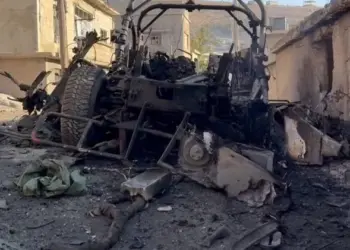
The SDF has continued to deploy suicide drones in front-line attacks against advancing pro-government forces: the SDF launched FBV drones near Al-Jarniyeh and other rural areas south of Kobane; while pro-government forces shot down several, one such UAV attack resulted in the death of an eight-year-old child in the village of Al-Qassimiyeh.
Even as fighting continued in scattered locations across frontlines near Kobane, the interim administration announced the beginning of a 15-day ceasefire—although this may have been motivated largely by the US’ desire to extract more ISIS detainees from the north-east rather than a sign of genuine de-escalation between the government and SDF.
Ongoing political talks will determine next steps, with rumors of a possible breakthrough—that would see Internal Security units enter Kurdish-majority cities while pro-government forces adhere to the 15-day truce—potentially derailed by low levels of trust between the two sides and high tensions on frontlines.