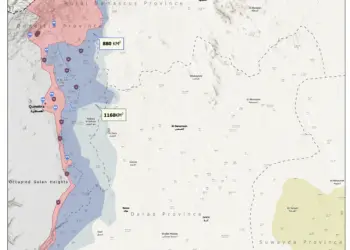
Over one year ago, pro-government forces launched a brutal attack on Suwayda province that left an estimated 1,700 dead. There has been no substantive change in Suwayda’s conflict lines since last year. Interim authorities still control the western countryside, while Israel’s red line protecting the province against any major attack from Damascus remains in place. While the violence and the lack of meaningful accountability in its aftermath turned most of Suwayda’s Druze residents against Damascus, it is important to recognize that today’s stand-off pre-dated the 2025 offensive. The underlying issues between Damascus and Suwayda were based on rights, representation, governance and, in the wake of the offensive, accountability for the events of last July. In the aftermath of the July 2025 offensive, Suwayda’s most powerful political and military bloc is organized under the leadership of Sheikh Hikmat al-Hijri, who is calling for an independent Suwayda—predictably a non-starter for Damascus. With positions hardened on both sides after last July, it is expected that the tense, uneasy calm in Suwayda will continue for the foreseeable future.
Background: One-Year Anniversary of Suwayda Violence
One year after interim authorities launched an offensive on Suwayda, the province remains locked in political and military stalemate. There has been no meaningful change to frontlines since last year’s violence ended in late July, and the same sticking-points dating from the immediate post-conflict stalemate—including the stand-off over Suwayda’s political status and persistent calls for genuine accountability—remain unaddressed. As such, Suwayda’s Druze leadership have in the past year turned to gradual tactical changes aimed at securing maximum service benefits from Damascus while maintaining military and security independence. This has led to the emergence of multiple power centers and governance structures (parallel to those of Damascus) that coordinate with each other under the “central” Druze authority as represented by Sheikh al-Hijri.
Steps to formalize Suwayda’s de facto autonomy from Damascus followed soon after the cessation of hostilities in mid-July 2025. That August saw the formation of the Druze National Guard—effectively an umbrella for the many different Druze factions in Suwayda that were either supportive of Sheikh al-Hijri’s project or sufficiently antagonistic towards interim authorities to ally with those groups. Groups under Damascus-linked individuals like Laith al-Balous and Suleiman Abdelbaqi were sidelined within Suwayda due to their material or political support for the offensive, while al-Balous and Abdelbaqi themselves retreated from Suwayda with pro-government forces after the ceasefire. That same month, the Druze leadership inaugurated the Higher Legal Committee as a Suwayda-based civil and political body to document the humanitarian situation in the wake of the offensive and effectively represent the province politically in lieu of central authorities.
Negotiations between the two sides have yielded some symbolic successes, but no genuine easing of tensions. The main part of the negotiations concerning Druze civilian hostages held by interim authorities since July 2025 effectively concluded with the prisoner exchange completed on 27th February this year. While the US-mediated handover was regarded as an important step, it was soon mired in accusations and counter-accusations that interim authorities still held dozens more individuals unaccounted for—presumed either killed or missing.
Rights, Abuses & Calls for Accountability
Last year’s offensive in Suwayda saw brutal, often sectarianized, and inter-communal violence. The brunt of it was perpetrated by pro-government forces, which conducted multiple massacres against civilians and repeatedly perpetrated indiscriminate violence in civilian areas. However, Druze factions were also responsible for carrying out retributive violence against Bedouin civilians in different areas of Suwayda.
To date, the most authoritative account of violations during the Suwayda offensive comes from the UN’s Independent International Commission of Inquiry (COI) on Syria and its March 2026 report. Violations recorded by the COI include killing of civilians, desecration of the dead, arbitrary detention, forced displacement, sexual violence and looting and destruction of civilian objects and properties. Some key findings of the report included:
- The Suwayda offensive resulted in an estimated 1,700 dead, 986 injured and 200,000 displaced from their homes;
- Most recorded deaths were among the Druze community, including 1,190 men, 99 women, 22 boys and 31 girls;
- Among the local Bedouin community, an estimated 53 men, nine women, five boys, and three girls were killed;
- At least 225 members of the government forces were also killed (134 from the interim Ministry of Defense and 91 from the Ministry of Interior), many due to the Israeli airstrikes targeting Suwayda and Damascus from 14th-16th July.
The report describes the offensive in three “waves”:
- 14th-16th July: Government forces and tribal figures attacked Suwayda;
- 16th-18th July: Druze groups attacked Suwayda’s Bedouin community in retribution;
- 17th-19th July: Tribes mobilized against Suwayda’s Druze.
The largest number of documented killings took place during this third wave, during which time government forces operated alongside tribal fighters. Also during this wave, as many as 35 villages in Suwayda’s western and northern countryside were destroyed.
This goes some way to explaining the bad blood on both sides but also why accountability for abuses during the offensive has constituted a cornerstone demand from Suwayda’s Druze leadership in its aftermath.
Verified Violations
In many cases, combatants failed to distinguish combatants from civilians. In several instances, several members of the same family were killed in single incidents: for example, on 25th August, eight members of the Badriyeh family were killed when their car was directly hit by shelling as they attempted to flee attacks in Sahwat Balatah, a village south-east of Suwayda city.
Perpetrators of violence in Suwayda also targeted vulnerable populations. Children, the elderly and disabled persons were among the victims of the violence. ETANA was able to verify four incidents of children and adolescents being killed: three of them Druze and one Bedouin.
The disabled were also not spared. In Walgha, in Suwayda’s north-west countryside, a mentally disabled adult man (aged 40) was killed despite his visible impairment. He was still in the care of his elderly parents, both of whom were also killed by unknown armed fighters. Meanwhile, in northern Suwayda’s Radimat al-Liwa, a widely shared video showed a man mockingly playing the oud over the body of a man on the street. Based on the attire of the individual, ETANA identified him as a tribal combatant from the north-east; Suwayda24 reported he was from Dhiban, Deir Ezzor. The deceased was identified by local outlets as an adult male with cerebral palsy.
Accountability Efforts
Even so, interim authorities have implemented minimal accountability measures. While the government formed a National Investigation Commission meant to investigate events and abuses in Suwayda, its work has been piecemeal and designed more to project an image of process and accountability rather than actually trying to heal wounds left by the conflict in the south. Of two statements made by the National Investigation Commission concerning the Suwayda massacres, one, in November 2025, included a pledge to hold those involved in the violations in Suwayda accountable. However, the second, a press conference announcing initial findings from the investigation, made several claims contradicted by field reports and witness testimonies—including that no foreign fighters were involved in the offensive.
The committee was expected to release its final report in January 2026 after requesting a two-month extension of its mandate. However, no further statement was issued until July this year, when Ezzedinne announced that the Military Criminal Court in Damascus had begun reviewing the events that occurred in Suwayda and had referred one of the accused to the military investigating judge (without naming the accused).
Interim authorities announced that the second session of the trial of those involved in the Suwayda events before the military court was held on 13th July. It included 23 defendants whose cases were documented by the COI. The indictment did not include any commanders at the level of group leader or higher. This latter point appears to demonstrate that outside pressure can force interim authorities to act, whereas there is little to no impetus to acknowledge—let alone atone for—wrongdoing from within the administration itself. Perhaps unsurprisingly, there has been almost complete rejection of the local accountability process.
Political Dynamics
In the immediate aftermath of last July’s offensive, the Higher Legal Committee emerged as the main political body in Suwayda to rival Damascus-affiliated institutions. Originally mandated to exist for six months, the committee was tasked with four main activities:
- Organizing relief efforts;
- Documenting the numbers of killed and missing persons, detainees (or abductees) and overseeing negotiations with interim authorities regarding information about their fates or potential releases;
- Assessing material damage resulting from the offensive;
- Overseeing the work of Suwayda Governorate’s council.
These responsibilities indicate the urgent, post-offensive concerns of the Druze leadership and the temporary nature of the committee. Even so, the committee eventually overran its six-month mandate and became the target of public criticism within Suwayda following tensions around interim government appointments to governorate-level directorates, leading to its dissolution in 2026.
For the time being, Druze institutions remain financially dependent on interim directorates for salaries and operational budgets, even while trying to maintain a degree of administrative independence. This reality involves several directorates and entities, including the Governorate Council, the Health Directorate, the Transport Directorate and the Syrian Electricity Company. While this measure may eventually expand to include other directorates, it is being managed without establishing any actual interim government presence within Suwayda.
Ceasefire Violations & Front-Line Deployments
The ceasefire agreement reached in July 2025 outlined a cessation of hostilities but no plans for withdrawals from areas of western Suwayda taken by pro-government forces. As such, the agreement represented an internationally mediated and guaranteed truce but one that did little to address conditions on the ground that invited further conflict. Unsurprisingly, there have been multiple ceasefire violations on both sides in the past year, though overwhelmingly committed by pro-government forces.
Between 1st August 2025 and 7th June 2026, pro-government forces (including official interim security forces and tribal militias affiliated with interim authorities) committed at least 300 ceasefire violations, targeting either National Guard positions or civilian areas within the city of Suwayda. These violations resulted in the deaths of 18 people from Suwayda, including 10 civilians within the city, while another 135 people were injured. Conversely, four ceasefire violations were committed by the National Guard, all originating from north-west of the city.
Ceasefire violations by pro-government forces along conflict lines in Suwayda have had observable effects in the build-up of pro-government forces in the western part of the province and the partial blockade on Suwayda. Violations in areas west of Suwayda city have repeatedly targeted main power lines supplying the province likely as part of the interim authorities’ sustained pressure campaign.
Military & Security Dynamics
The July 2025 offensive led to the collapse of the organized base of local forces within Suwayda. Pre-existing divisions were brought into the open while new divisions emerged (such as the displacement of factions from areas of western Suwayda occupied by pro-government forces). Suwayda’s Druze leadership therefore deemed it necessary after the ceasefire to comprehensively reorganize military and security forces in the province to improve defensive capabilities and to reorder forces for political and military reasons in the wake of the new reality.
As such, August 2025 saw the formation of the National Guard and an accompanying Internal Security apparatus. This reorganization encompassed approximately 90% of local factions, while the Men of Dignity Movement (Harakat Rijaal al-Karameh) and Mountain Brigade (Liwa’ al-Jabal), along with some smaller allied groups, remained effectively outside the organizational framework—even though some were still nominally affiliated with the National Guard.
National Guard
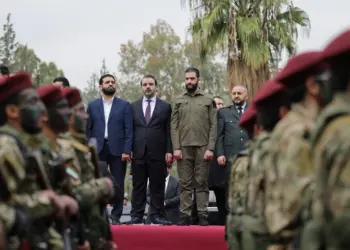
Senior Druze commanders launched a comprehensive reorganization in late July 2025, dividing the province into military sectors and appointing commanders for each. Recruitment was subsequently opened for men between the ages of 18 to 28. With field preparations underway, the National Guard was officially established on 23rd August 2025. The National Guard’s current tasks within Suwayda focus on controlling and organizing forces deployed on front lines facing pro-government forces and intervening in internal security operations within Suwayda when necessary.
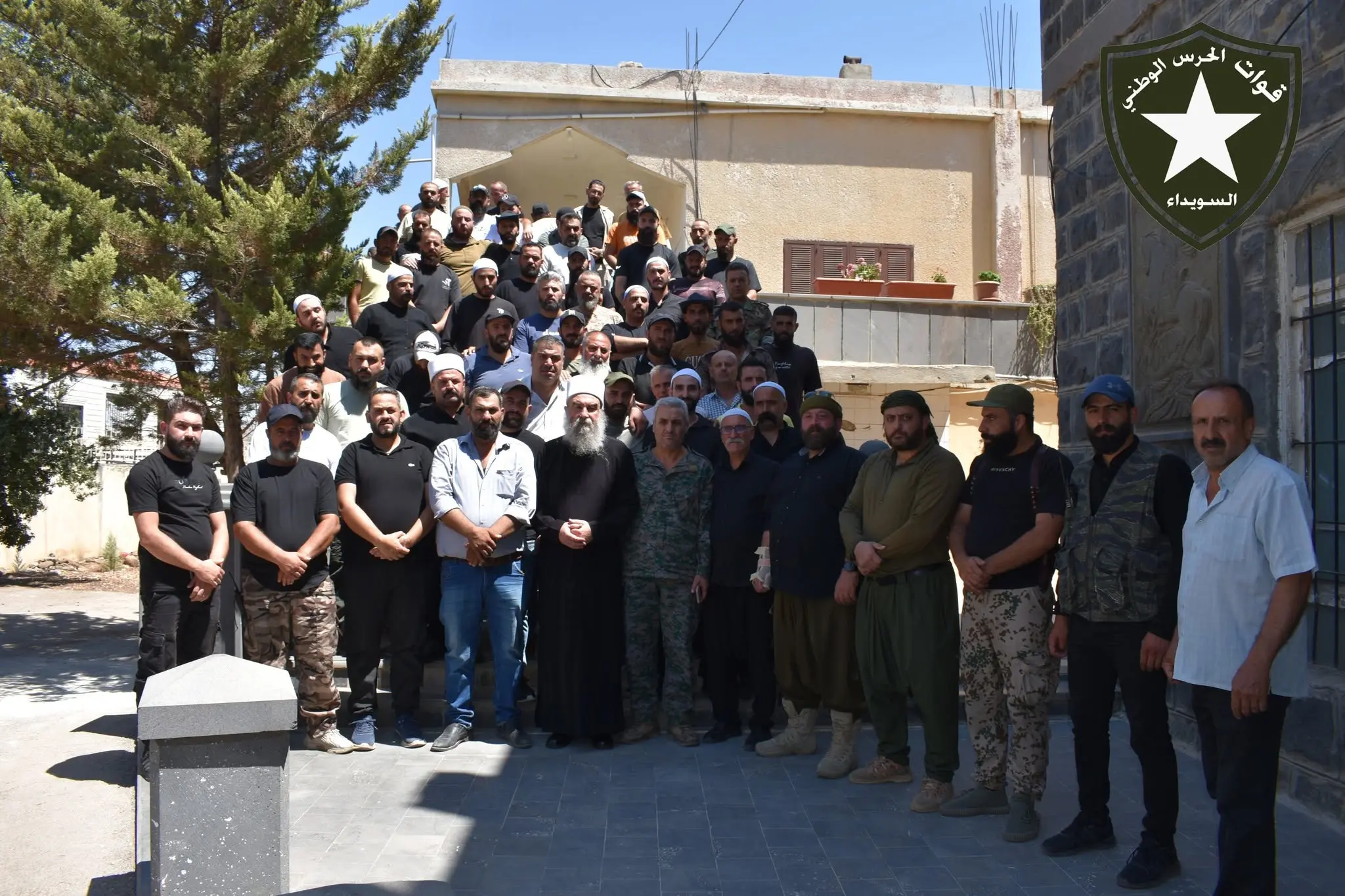
Groups Opposed to the National Guard, Sheikh al-Hijri
A minority of armed factions and civilian groups are opposed to the National Guard project and seek greater political and military roles within Suwayda. However, these figures and groups are stymied by the relatively widespread presence, size and organization of forces operating under or affiliated with the National Guard.
The Men of Dignity Movement and the Mountain Brigade constitute the two main factions within this bloc, in addition to smaller groups and gangs. In August 2025, the two main factions announced changes to their leadership in an attempt to appease local residents following their coordination with interim authorities and their subsequent withdrawal during the offensive. Despite this, both factions are still broadly viewed with suspicion within Suwayda and are considered unqualified to hold sensitive military positions on front lines.
Security Dynamics
Despite the end of the offensive and the consolidation of the National Guard and other Druze governance projects, Suwayda remains a prodigiously complex security landscape. Assassinations remain an intermittent reality in the province, contributing to a sense of general anxiety among the local population and reducing public confidence in checkpoints.
Assessment
The lack of meaningful accountability measures and the ongoing political stalemate between Damascus and Suwayda indicate that interim authorities do not accept the status quo in the south and would prefer to see the Druze governance experiment brought to heel. Although this has been framed by interim authorities and outside observers as an issue principally between Damascus and al-Hijri, today’s political tensions pre-date the 2025 violence.
The aftermath of last year’s offensive hardened positions on both sides, which goes some way to explaining the ongoing impasse. While there has been no change in the conflict map for one year since the July 2025 offensive, Suwayda’s Druze still have the support and backing of Israel and the same Israeli red lines remain in place. As such, it is expected that the tense, uneasy calm in Suwayda will continue for the foreseeable future.