Israeli forces penetrated the western Daraa countryside area of Ma’ariyeh for the first time and established military points, expanding Tel Aviv’s territorial sphere in Syria and triggering alarm among residents increasingly fearful of Israel’s intentions for the region. Interim authorities are coming under mounting domestic pressure to formulate an effective response to increasingly brazen and near-daily violations of Syrian sovereignty by Israeli forces. Concerns surrounding sovereignty and fears of further Israeli expansion—or the eventual annexation of parts of south-west Syria—represent one of the few issues capable of generating deeply felt consensus across the country. The interim government’s continued inability to deter increasingly aggressive Israeli violations, whether through back-channel diplomacy or a reassessment of Syria’s defensive posture toward the ongoing Israeli presence in the south, risks an escalated localized response that could spiral beyond Damascus’ control despite its attempts at containment and appeasement.
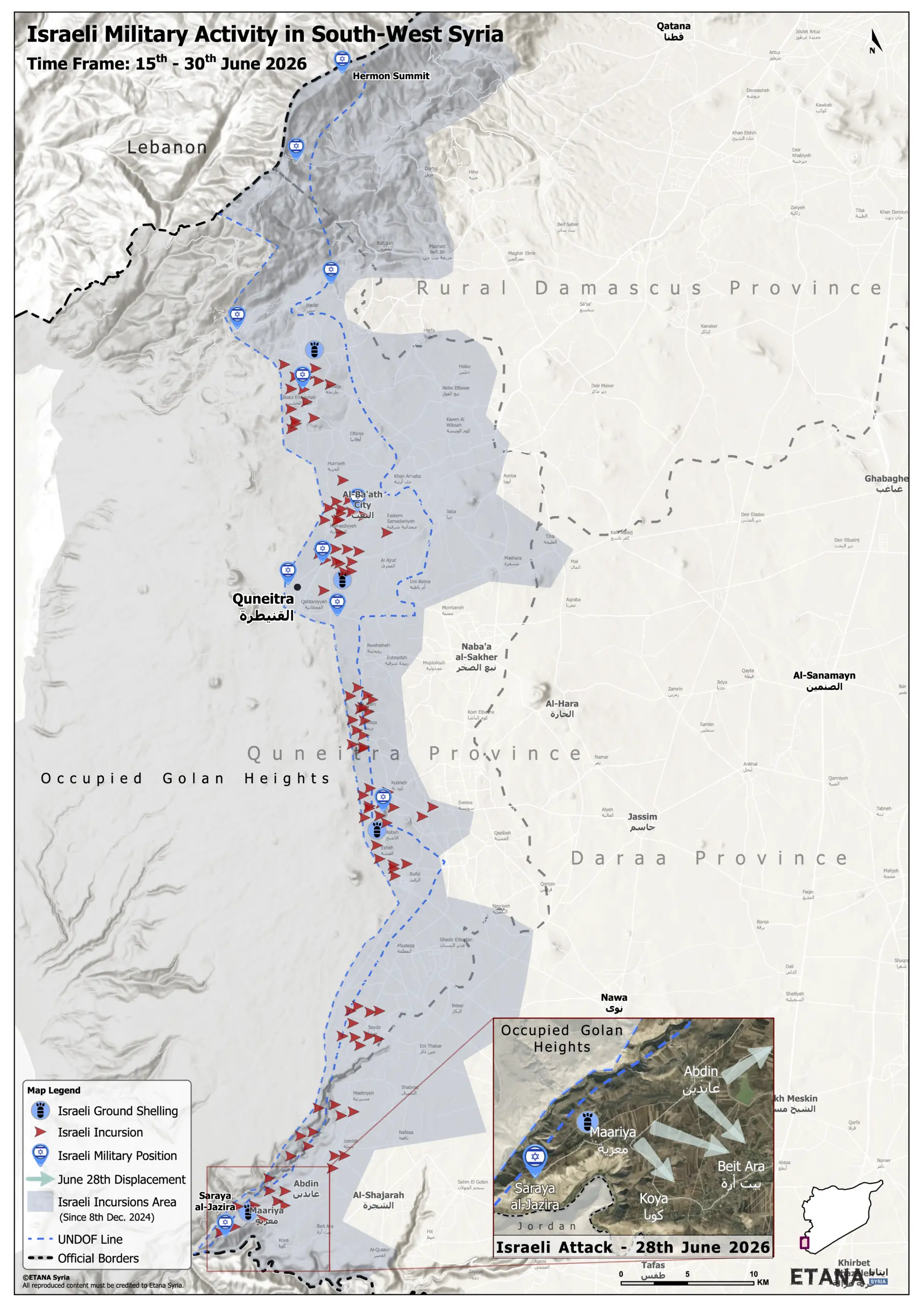
Israeli Incursion into Western Daraa
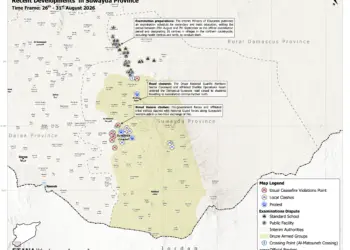
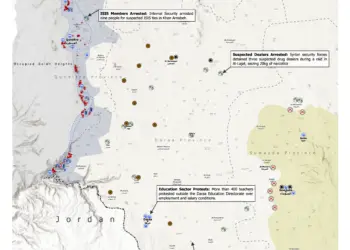
Israeli forces have continued expanding security operations in western Daraa in recent months, moving beyond episodic incursions toward more persistent forms of direct security interference in local life. In recent months, ETANA has monitored Israel’s intensifying activity across western Daraa, where ground forces regularly establish temporary checkpoints, carry out search raids and conduct military patrols.
The latest escalation from Israeli forces began over the weekend of 28th June, when units entered and established a new position west of the town of Ma’ariyeh in the western Daraa countryside. While modest in military terms, the development represents one of the clearest recent signs of Israel’s expanding sphere of control and the geographic footprint of the Israeli army inside Syria, entering and establishing sites in populated centers that have not previously experienced Israeli occupation. The deployment followed other ongoing Israeli incursions and patrol activity across western Daraa in recent weeks and was preceded earlier the same day by an Israeli strike targeting a vehicle near Hader in northern Quneitra that killed two people.
Word of the Israeli deployments near Ma’ariyeh spread quickly in the region and, within hours, dozens of residents in the neighboring town of Abdin blocked roads with large rocks in an attempt to prevent any further Israeli advances into the area. After Israeli soldiers entered the town, local youths and children confronted the force by throwing stones. The altercations later escalated after gunfire was directed at Israeli patrol elements, forcing the units to withdraw. Israeli forces subsequently responded with mortar rounds fired toward the outskirts of Abidin from an Israeli military position in the western Daraa countryside; heavy machine-gun fire was also reportedly directed from helicopters. Despite the escalation, no casualties were reported. The escalation was accompanied by the deployment of helicopters and reconnaissance aircraft, which maintained a continuous presence over western Daraa for hours after the Israeli attack had concluded. The initial Israeli position established near Ma’ariyeh was withdrawn later that same day.
The Israeli attacks sent families fleeing from the affected areas and nearby locales, prompting the displacement of hundreds from the confrontation zone. Between 400 and 500 residents from the towns of Abidin and Ma’ariyeh reportedly fled toward the nearby town of Al-Shajarah in the western Daraa countryside. The movements were primarily of civilians, driven by fears of broader escalation and additional Israeli military activity in the area. During the early morning hours following the confrontations, patrols from the United Nations Disengagement Observer Force (UNDOF) entered the affected area and reportedly gathered testimony from residents regarding the events.
Israeli Activity in Post-Assad South Syria
Since Bashar al-Assad fled Syria and his regime collapsed in early December 2024, Israeli forces have made regular incursions into Syrian territory. Israeli patrols repeatedly advance several kilometers into Syrian territory on an almost daily basis, while raid operations have extended as far as 4km beyond the border area, often resulting in the illegal detention and temporary transfer of Syrian citizens across the border strip into the Israeli-occupied Golan Heights. More than 15 such arrest operations have been recorded over the last two months since May 2026. Concurrently, Israeli forces have imposed increasingly restrictive measures on civilian activity, preventing farmers from accessing agricultural land within a few kilometers of the border area except through prior coordination arrangements and the issuance of access cards.
Interim Government Response
Authorities have simultaneously sought to contain the emergence of uncontrolled local armed responses while avoiding a wider confrontation. In a major break from recent precedent, interim authorities moved rapidly to contain the situation following the confrontations in western Daraa. Interim security personnel were deployed across the Yarmouk Basin area and surrounding localities overnight, where forces established checkpoints and screening measures intended to monitor movements into the area and prevent armed individuals from entering confrontation zones.
Deployments by security forces appear intended not only to regulate movement but also to prevent local armed actors from approaching areas experiencing heightened tensions. No further confrontational incidents involving Israeli forces were recorded during the subsequent days after the Israeli attacks on Abidin, while interim security forces’ positions reportedly remained active in efforts to stabilize the situation.