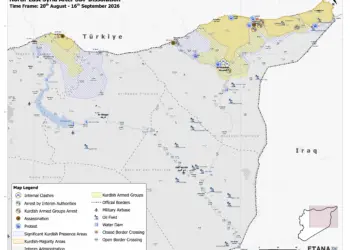
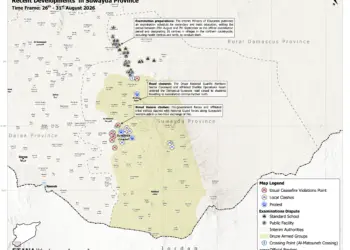
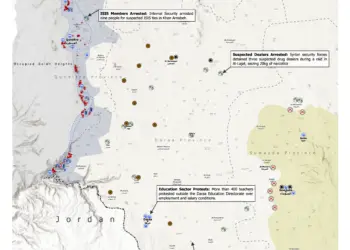
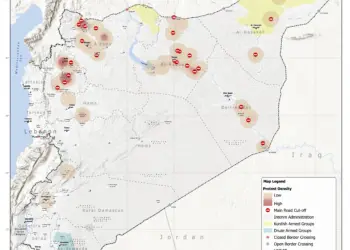
The past month has been characterized largely by continuity in Syria’s north-east, with the slow, though generally forward-moving, progress of integrating Syrian Democratic Forces (SDF) personnel under the interim Ministry of Defense. The establishment of four fully integrated SDF brigades, now receiving salaries directly from the central government, marks a substantive milestone and offers a potential template for subsequent phases of force incorporation, even as disputes over organizational design and command hierarchies remain unresolved. At the same time, the question of integrating internal security structures—specifically the Asayish—is emerging as the next, and potentially more contentious issue, given their central role in maintaining day-to-day control on the ground in Hasakeh.
Damascus-SDF Security Integration
Integration efforts between the Syrian Democratic Forces (SDF) and Damascus have continued to progress in the same plodding but overall progressive trajectory. Generally, most discussions continued to center on organizational and administrative issues rather than implementation on the ground, although concrete steps have been observed on the latter as well. Negotiations remain ongoing regarding the future absorption of remaining personnel and key questions remain surrounding the structure of future divisions and brigades. On the ground, the SDF’s parallel security structures remain firmly in place across much of north-east Syria. Although coordination has continued to expand since January, the SDF continues to exercise substantial independent military and security authority throughout the region.
Despite the centrality of territorial and armed forces mergers, the ultimate question of control on the ground in north-east Syria is closely tied to the integration of Asayish forces—the SDF’s police and internal security apparatus responsible for local policing, prisons and most internal checkpoints in the region. Accordingly, this has been one of the most sensitive components of merger talks and a major blockage in implementation. While the final structure of the Asayish remains unresolved, May witnessed some of the clearest indications to date that integration efforts are moving beyond negotiations and into practical stages.
Prisoner exchanges continue to be a bright spot in negotiations, a point of substantial progress with relatively uncontentious goals shared by both sides. Interim authorities released approximately 250 SDF-affiliated detainees during the first week of May, followed by an additional 88 detainees later in the month. Newly appointed deputy governor of Hasakeh, presidential insider Ahmad al-Hilali, subsequently stated that the majority of the detainee file had been resolved and suggested that additional releases could soon conclude the process entirely. However, detainee issues continued to generate tensions in some regions: early May saw relatives of detained SDF personnel organize protests in Hasakeh to demand further releases, while Abdi accused Damascus of dragging its heels in its commitments related to detainees and IDPs.
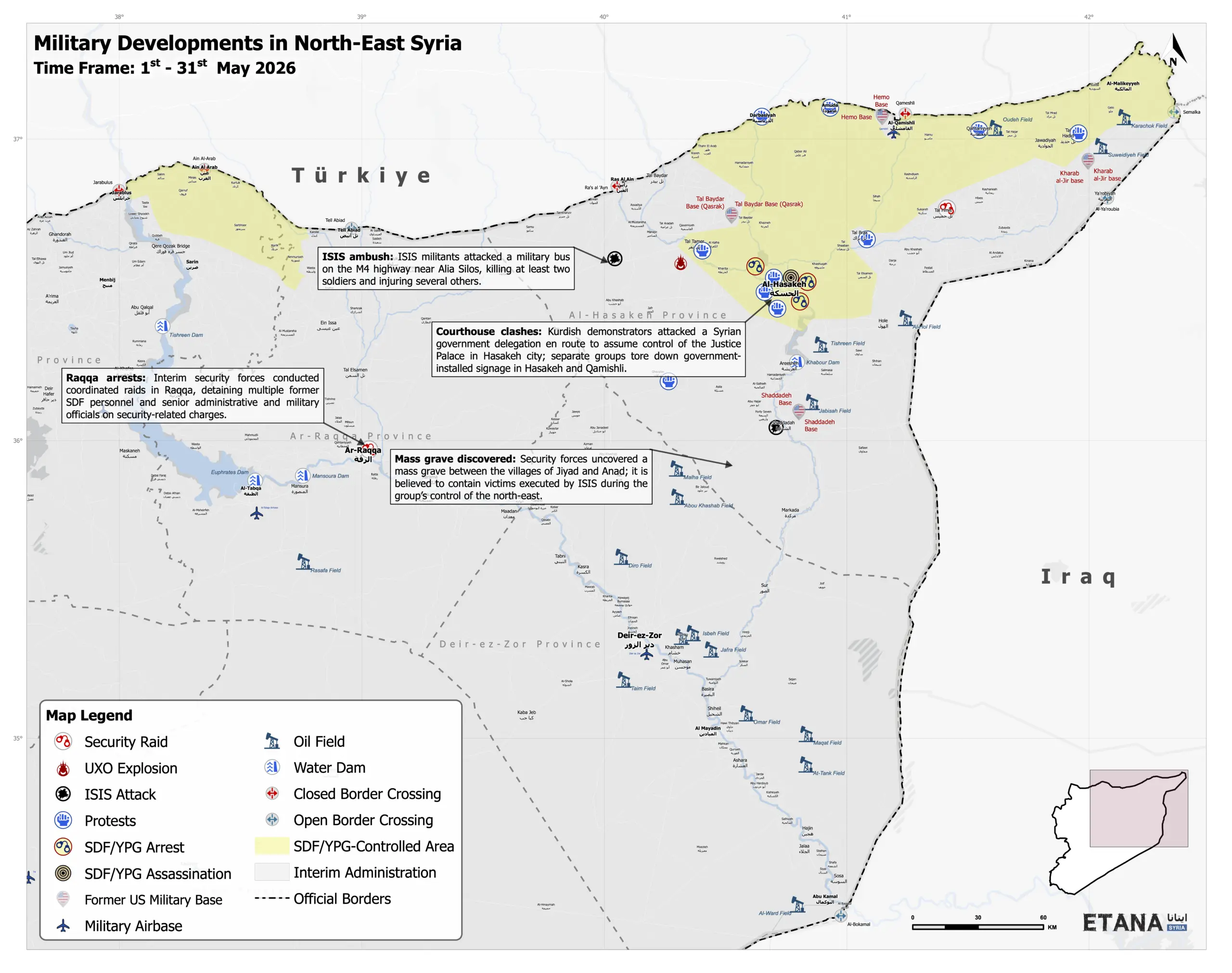
Amidst integration efforts, ISIS has continued to reconstitute and launch a small but growing number of attacks against security forces across the north-east. ISIS militants ambushed a military bus on the M4 highway near Alia Silos, killing at least two soldiers and injuring several others on 11th May. The following day, the group claimed responsibility for a related attack in rural Hasakeh near Ras al-Ain. Separately, interim security forces uncovered a mass grave between the villages of Jiyad and Anad, believed to contain the bodies of victims of earlier ISIS executions.
Political & Humanitarian Developments
Interim authorities in Damascus recently elevated several figures from both sides of the January integration agreement to more senior roles, most notably Ahmad al-Hilali—previously spokesperson for the presidential delegation responsible for overseeing the agreement—to the role of deputy governor of Hasakeh. Days later, former SDF military media official Helzwar Ismail was appointed as a military media officer responsible for the north-east region within the interim Ministry of Defense. General Ziyad al-‘Ayish, who had previously overseen implementation of the agreement on behalf of the presidency, was also reassigned as governor of Deir Ezzor. Together with the continued public role of Sipan Hamo as deputy defense minister, the appointments reflect the growing incorporation of integration-linked figures into emerging integrated state structures across north-east Syria, with interim authorities promoting trusted advisers and representatives based on their successful performance on integration so far.
Some of the most visible turmoil in recent weeks has centered on efforts to integrate judicial institutions in Hasakeh and Qamishli into state structures. On 6th May, SDF-installed “Social Justice Council” signs were removed from judicial facilities and replaced with “Justice Palace” (Qasr al-Adel) signs displaying the Syrian state emblem in Arabic and Kurdish, while officials announced plans to evaluate Self Administration judicial personnel for possible incorporation into state institutions moving forward. The measures almost immediately sparked anger among some segments of the more hardline Kurdish political base. The following day, a group of demonstrators attacked an interim government delegation attempting to assume control of the Justice Palace, damaging vehicles and forcing the convoy to withdraw, while other groups removed government-installed signs and raised Kurdish flags over judicial buildings in both Hasakeh and Qamishli. SDF supporters subsequently removed and destroyed replacement signs on multiple occasions, while Asayish personnel responsible for securing the compounds largely refrained from intervening. Although interim authorities temporarily withdrew to avoid escalation and later reached an understanding regarding the dispute, the episode underscored several fraught political issues within the integration roadmap: the visible return of state institutions and centrality of symbols has continued to spark conflict, while the refusal of Asayish forces to maintain order hints at deeper political divisions within the SDF—even as its forces are officially folded into national structures.
Economic Developments
Significant progress was recorded in the agricultural sector during May, where cooperation continued to advance more smoothly than in military or political files. An interim government delegation and Self Administration officials agreed to establish joint supervisory and local committees to oversee procurement of the 2026 wheat harvest, representing a further step towards sustained practical coordination between the two sides. Later in the month, the interim Ministry of Agriculture tasked the director of Hasakeh’s Agriculture Directorate with overseeing the integration of Self Administration agricultural institutions into their state counterparts. The measures suggest that agriculture is increasingly following a similar trajectory to healthcare, where technical and service-oriented sectors have proven more conducive to integration than security institutions.
In contrast to agricultural coordination, the issue of oil extraction and revenues remains highly contentious. The Self Administration announced the creation of the new “Hasakeh Fields Administration” to oversee the region’s oil sector, with no indication of interim government participation in the new structure. The move comes amid efforts by Damascus to increase anemic production rates in Deir Ezzor, particularly the Al-Tanak oil field, south of Al-Omar, where oil extraction remains mired at less than 5% of pre-war levels. Meanwhile, economic links with neighboring states have showed signs of gradual recovery, with increased Iraqi oil shipments entering Syria through the Al-Yaroubiyeh crossing and growing tanker arrivals at the Banyias refinery. In the same current, the iron bridge at the Semalka crossing was fully reconstructed and commercial activity resumed, following damage incurred by severe floods back in March.