Interim authorities reached a deal with the Syrian Democratic Forces (SDF) on 30th January that established a new ceasefire in north-east Syria and outlined the integration of SDF, Asayish and Self Administration personnel into interim government bodies within a month. Although there are still disagreements about the finer details of the agreement, the SDF—now diplomatically isolated and all but defeated as a military and territorial force—has few options left. Contrary to many observers’ expectations, the SDF’s collapse was swift—a result of its diplomatic isolation (particularly the loss of US patronage) after the fall of Bashar al-Assad and long-declining popular legitimacy in the north-east. The latest agreement with interim authorities will therefore likely spell the end of the SDF as a military force and territorial presence in the region, as well as the Kurdish-led governance experiment that it spearheaded.
For its part, the interim administration appears committed to the deal and has issued strict orders to its forces to respect it, but in coming weeks will have to navigate a complex integration process designed to structurally and ideologically dismantle and reconstitute the SDF’s forces into interim structures—a process still mired in political sensitivities and logistical questions.
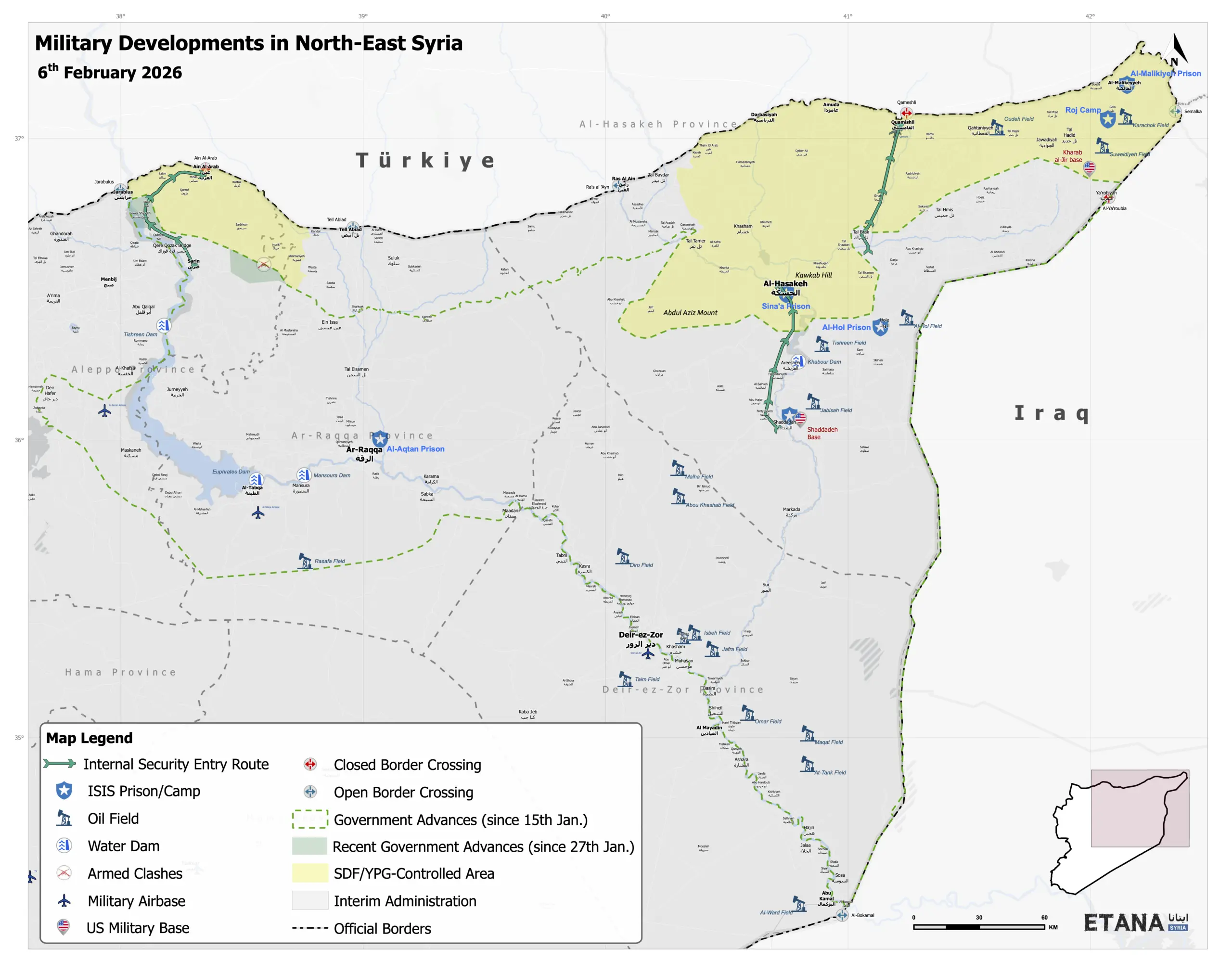
Background
Interim authorities reached a deal with the SDF, announced on 30th January, outlining the gradual integration of the Kurdish-led force under the interim Ministries of Defense and Interior. According to state-run outlet SANA, the latest deal included a “comprehensive” ceasefire agreement and outlined the “phased integration of [SDF] military and administrative forces.” According to the deal:
- All military forces will be withdrawn from Kobane/Ain al-Arab, Hasakeh and Qamishli, to be replaced by Internal Security units (under the Ministry of Interior);
- The SDF will withdraw its forces to Al-Malikiyeh, as well as the towns of Al-Darbasiyeh and Rumeilan, all located within the border triangle in far north-east Syria;
- A military division will be formed comprising three brigades of former SDF forces in the north-east and one brigade of forces in Kobane/Ain al-Arab;
- SDF-affiliated Asayish units will be integrated into Internal Security;
- Self Administration institutions will be integrated into interim governance structures, with former Self Administration employees regularized as state civil servants;
- Kurdish civil, educational and linguistic rights will be guaranteed.
Although the response from international stakeholders has been overwhelmingly positive, subsequent statements from both interim government and SDF representatives indicated potential disagreements over the finer details of the deal. An anonymous government source speaking to SANA emphasized that SDF integrations into interim bodies would be “on an individual basis within the brigades.” Self Administration figure Ilham Ahmad meanwhile claimed that Internal Security units would enter Hasakeh and Qamishli to oversee the integration of the Asayish and then withdraw, adding that the SDF would appoint the governor of Hasakeh. SDF commander Mazloum Abdi described the Internal Security deployment as limited to security zones in Hasakeh and Qamishli, “and their sole task will be to monitor the integration process before withdrawing.”
Implementation of Ceasefire/Integration Agreement
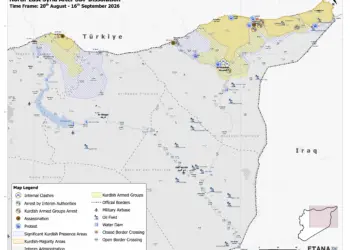
Internal Security units were originally meant to enter Kobane/Ain al-Arab, Hasakeh and Qamishli starting on 30th January, however the SDF requested an extension until after the following weekend. As such, Internal Security units, comprising some 1,500 personnel, entered Hasakeh on 2nd February—notably accompanied by US-led International Coalition vehicles. They took over SDF headquarters including the Traffic Department (which has since been designated as an Internal Security operations center). The following day, Internal Security personnel entered Qamishli, taking up positions in former Self Administration buildings and security zones.
Prior to their entry, interim authorities appointed Colonel Marwan al-Ali as director of Internal Security in Hasakeh province. According to media reports, al-Ali previously served as a security commander in Hay’at Tahrir al-Sham (HTS). His appointment therefore fits into a broader trend of post-conquest appointments by interim authorities that have prioritized factional and ideological loyalists rather than taking a more concessionary, inclusive approach.
The situation is more complex in Kobane/Ain al-Arab and Amouda. Internal Security advanced into areas surrounding north-east rural Aleppo’s Kobane—entering the town of Al-Shuyoukh and taking over all former SDF headquarters there on Monday—but not the city itself. The ceasefire agreement also granted special status to the Hasakeh town of Amouda, in that it will be subject to the same security provisions as Hasakeh and Qamishli, but with a political role given to the Kurdish National Council (KNC) that is affiliated with authorities in the Kurdistan Region of Iraq (KRI).
Despite the evident progress made in negotiations, the north-east witnessed scattered outbursts of violence during the course of negotiations. Late last week, pro-government forces stationed in the former Operation Peace Spring area shelled SDF positions in several villages near Tal Tamr; the SDF retaliated with artillery before UAVs launched by pro-government forces targeted SDF vehicles on the southern outskirts of Tal Tamr.
More significantly, an unknown group opened fire on Internal Security units as they entered Hasakeh; the SDF itself responded to the source of gunfire, killing four people, and later stated that “terrorist” elements were responsible.
Otherwise, most post-ceasefire violence has targeted civilians. Although the SDF has imposed curfews between 06:00 and 18:00 in areas still under its control, civilians in different areas either went outside to welcome Internal Security units or celebrated their arrival afterwards. Celebrating residents in Arab districts of Hasakeh came under fire from SDF-affiliated Revolutionary Youth militants. The SDF itself opened fire on people gathered to welcome Internal Security units in Safiyeh, north of Hasakeh, resulting in eight injuries and one death.