Through negotiations on integrating the Syrian Democratic Forces (SDF) and Self Administration institutions as well as some conciliatory political appointments, north-east Syria’s ceasefire/integration agreement is seeing a unique—albeit limited and contested—form of decentralization not seen in any other part of the country. However, familiar governance practices from interim authorities, with Hay’at Tahrir al-Sham (HTS) insiders appointed to strategic fulcrum positions related to job allocations, fuel, agriculture and security, may point to longer-term objectives. The current aim so far seems to be avoiding binding appointments while extracting immediate benefits from the agreement (such as fuel extraction) and avoiding a resumption of military hostilities. The agreement is expected to hold for the foreseeable future.
Despite some progress in implementing the agreement, however, tension and mutual suspicion prevail on the ground. There is an observable trend of interim authorities appointing HTS insiders with a history of opposition to (and even active wartime hostilities against) the People’s Protection Units (YPG) and SDF in north-east Syria. Appointments of HTS insiders from north-west Syria in positions in Raqqa, meanwhile, have received vocal opposition. Even then, although talks on military integration are proceeding, there has been little material or actual progress made beyond the sharing of personnel lists and agreements on locations for ex-SDF brigades, and it is steps like this that could prove the biggest threat to the implementation of the agreement moving forward.
Background
The ceasefire and implementation agreement brokered in late January, which came into effect on 30th January, brought to an end hostilities that had reached from central Aleppo city to deep inside the SDF-controlled north-east Syria through December and January.
Previous ceasefires—following clashes in Aleppo’s Sheikh Maqsoud and Al-Ashrafiyeh districts in early January and eastern rural Aleppo’s Deir Hafer days later—were treated as temporary, tactical pauses by both sides. But this equation changed after pro-government forces advanced quickly across the Euphrates and deep into formerly SDF-held territory in Raqqa and Deir Ezzor, aided in large part by anti-SDF tribal militias handing over their tribal heartlands to advancing pro-government forces and/or initiating attacks on SDF positions before the arrival of official interim security forces. The SDF, facing the prospect of intense, ugly urban fighting in key urban centers like Hasakeh, Qamishli and Kobane/Ain al-Arab and—ultimately—the unsympathetic terms that would be imposed thereafter, decided to negotiate its way out of a corner.
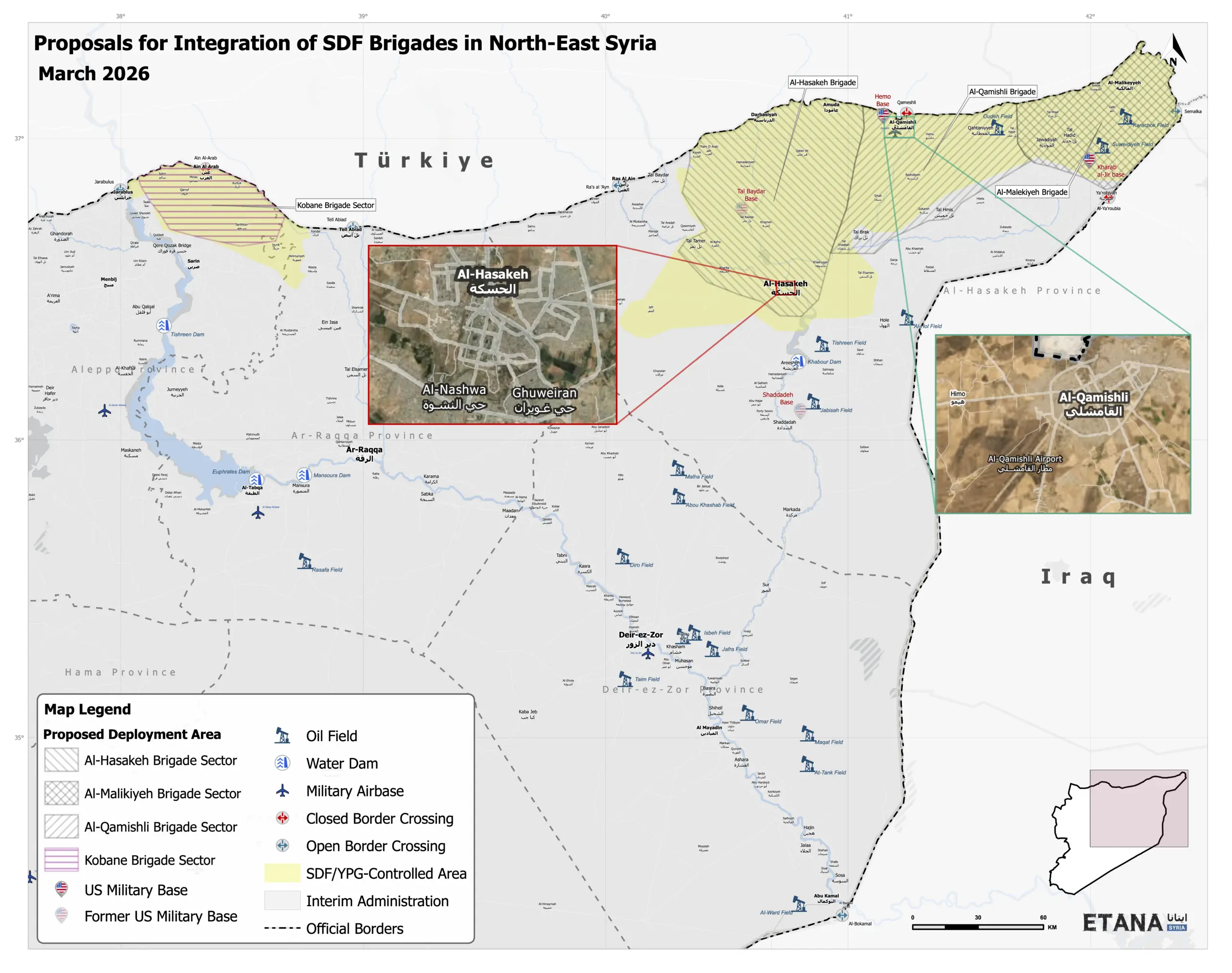
When the ceasefire came into effect, the SDF was still in control of Kobane/Ain al-Arab and surrounding countryside as well as two pockets of territory in Hasakeh province that included the governorate’s main cities (Hasakeh, Qamishli and Al-Malikiyeh) and the historically Kurdish-majority north-east corner of Hasakeh province. This remains the status quo today, although SDF units withdrew from Kobane following mediation with interim authorities in February.
Beyond the crucial ceasefire that would give way to integration implementation and negotiations, the official text of the 14-point agreement outlined various terms related to the military integration of the SDF and political/administrative integration of Self Administration bodies:
- An immediate and comprehensive ceasefire across all fronts and contact lines between the Syrian Government forces and the Syrian Democratic Forces (SDF), alongside the withdrawal of all SDF military formations to the east of the Euphrates River as a preliminary step for redeployment;
- The full and immediate administrative and military handover of Deir Ezzor and Raqqa governorates to the Syrian Government. This includes the transfer of all civil institutions and facilities, with the immediate issuance of decrees to permanentize current employees within the specialized ministries of the Syrian state;
- Integrating all civilian institutions in Hasakeh Governorate into the institutions of the Syrian state and its administrative structures;
- The Syrian Government shall take control of all border crossings, oil fields, and gas fields in the region, with protection secured by regular forces to ensure the return of resources to the Syrian state, while considering the special case of Kurdish areas;
- The full integration of all SDF military and security personnel into the structures of the Syrian Ministries of Defense and Interior on an “individual” basis following necessary security vetting, granting them military ranks, financial entitlements, and logistical requirements accordingly;
- The leadership of the SDF commits to refraining from incorporating remnants of the former regime into its ranks, and to providing lists of officers from the former regime’s remnants present in areas of northeastern Syria;
- The issuance of a presidential decree appointing a nominee to assume the position of governor of Hasakeh, as a guarantee of political participation and local representation;
- The removal of heavy military presence from the city of Ain al-Arab (Kobane), the formation of a security force drawn from the city’s residents, and the retention of a local police force that is administratively affiliated with the Syrian Ministry of Interior;
- The integration of the administration responsible for the ISIS prisoners and camps, as well as the forces responsible for securing these facilities, with the Syrian government, so that the Syrian government assumes full legal and security responsibility for them;
- The adoption of a list of candidates submitted by the SDF leadership to hold high-ranking military, security and civil positions within the central state structure to ensure national partnership;
- Welcoming Presidential Decree 13/2026, which provides for the recognition of Kurdish cultural and linguistic rights and for addressing outstanding rights-based and civil issues, including those of unregistered/stateless persons and accumulated property-rights claims from previous decades;
- The SDF commits to the removal of all non-Syrian Kurdistan Workers’ Party (PKK) leaders and members outside the borders of the Syrian Arab Republic to ensure sovereignty and regional stability;
- The Syrian state commits to continuing the fight against terrorism (ISIS) as an active member of the International Coalition, in coordination with the United States, to ensure the security and stability of the region;
- Working toward understandings concerning the safe and dignified return of the residents of Afrin and Sheikh Maqsoud areas to their homes.
As such, the agreement represented a bedrock understanding between the interim administration and SDF—comprehensive in scope but limited on detail—that paved the way for some initial implementation steps (chiefly, the formalization of Internal Security’s initial presence in urban centers in the north-east) and then further negotiations on different aspects of integration. The very first steps after the agreement therefore saw interim authorities appoint Colonel Marwan al-Ali as Internal Security chief in Hasakeh; the SDF, in response, appointed Siyamand Afrin, a Syrian Kurdistan Workers’ Party (PKK) member on the SDF’s General Command Council, as al-Ali’s deputy. Internal Security units then entered Hasakeh on 2nd February and Qamishli on 3rd February, in both cases accompanied by US-led International Coalition patrols, which took place without major incidents.
Military & Security Integration
While significant, Internal Security deployments into Hasakeh and Qamishli established a tense, piecemeal form of power-sharing in two of the north-east’s key cities: Internal Security troops occupied some government buildings while the SDF cordoned off their headquarters and introduced daytime curfews meant to restrict public celebrations welcoming pro-government forces—with some reports indicating that these curfews were applied unevenly, with Kurdish residents allow to come and go while more stringent measures were applied in Arab-majority areas.
It became apparent through statements from government and SDF figures in mid-February that the integration of the SDF would be in the form of four brigades under the interim Ministry of Defense, with one allocated to the Kobane/Ain al-Arab region and three others allocated to north-east Syria. The three north-east brigades would include the Hasakeh Brigade (covering the areas of Al-Darbasiyeh and Ras al-Ain), the Qamishli Brigade (covering Amouda, Qamishli, Tal Burak and Tal Hamis) and the Al-Malikiyeh Brigade (covering the area from Al-Malikiyeh to Al-Yaroubiyeh).
Progress made in these initial talks led interim authorities to formalize the integration process. On 12th February, interim authorities appointed General Ziad al-Ayish—originally from Hasakeh province, but a longstanding HTS official—as presidential envoy to oversee the integration process with the SDF. Later in the month, on 23rd February, the interim Ministry of Defense’s chief-of-staff received an SDF delegation, led by YPG commander Sipan Hamo, in Damascus to discuss military integration plans. The following day another interim delegation travelled to Hasakeh—this time led by al-Ayish in his new capacity as presidential envoy—for talks on military and administrative integration.
This combination of military and political matters discussed at meetings may have reflected interim authorities’ desire to test commitment to the agreement while lower-level government delegations started meeting with their counterparts in the Self Administration to discuss the nitty-gritty details of administrative integration starting in early February. As such, on 2nd March, Mazloum Abdi met with al-Ayish, Asayish commander Mahmoud Khalil and Hasakeh’s newly appointed governor for talks on integration of Asayish members into Internal Security and the interim Ministry of Interior’s forces; that same day, a government delegation arrived in Hasakeh to discuss integration of oil institutions.
Political Integration
The north-east’s political integration process began with the appointment of Noureddin Ahmad Issa as Hasakeh’s governor. A former official in the Asayish, Ahmad Issa met with interim President Ahmad al-Shara’a in early February and delivered a public address upon his return to Hasakeh stating that his nomination had been approved. The following days established something of a precedent about how the political dimension of the integration agreement has progressed since then: a lack of transparency and unclear intentions displayed by interim authorities as well as the use of competing public statements (particularly from the SDF’s side) to advocate for specific yardsticks in implementing an agreement that was comprehensive in scope but left large space for interpretation on details.
After Ahmad Issa returned to the north-east, the SDF announced on 6th February that it had reached an agreement with interim authorities to appoint him (the SDF’s nominee) as governor. The following day, Ahmad Issa entered the governorate headquarters in Hasakeh city and assumed his duties. And while Hasakeh Internal Security chief Marwan al-Ali issued a statement announcing that this decision had been reached, interim authorities refrained from issuing any official decree or statement to the same effect. SDF spokesperson Farhad Shami issued the first of several statements, effectively arguing that Damascus had reneged on certain clauses of the integration agreement. It was not until 12th February that the interim administration issued a statement referring to Ahmad Issa as the governor pick—although initially describing him as a charge d’affaires for the province—before state-run channel Al-Ikhbariyeh announced that al-Shara’a had officially appointed Issa. Hours later, a presidential decree was issued.
Though not necessarily confidence-building in terms of how it transpired, the approval of Issa allowed for other political work to begin on integration in earnest, with Issa often acting as an intermediary representative during different talks. The first administrative delegations from Damascus started visiting the north-east from 8th February—the first interim delegation, including Internal Security chief Marwan al-Ali and others, travelled to Qamishli International Airport to discuss with the SDF handover and future management of the airport.
With technical committee-level meetings well underway by mid-February, interim authorities started issuing official decisions to start integrating Self Administration institutions, appoint new sector chiefs and other officials in local positions in Hasakeh, and re-employ former public sector employees.
To date, the most progress in this regard has been observed in the governorate’s health sector, possibly because of its importance, service-based character and more apolitical nature compared with other integration files. So far:
- On 16th February, interim authorities appointed Dr. Khaled al-Khaled—an Arab former employee of the UNHCR in Hasakeh, considered a neutral civilian—as director of health in Hasakeh;
- On 17th February, Hasakeh governor Noureddin Ahmad Issa ordered formation of a committee to oversee integration of the Self Administration’s existing health structure under the interim Ministry of Health. Committee members included: the incumbent health chief in Hasakeh, Khaled al-Khaled, and Mamo Khalil Muhammad, the head of the Self Administration’s Health Authority;
- On 24th February, interim Health Minister Musa’ab al-Ali appointed Dr. Jiwan Shukri Hami—a Kurdish orthopedic surgeon previously working for the Self Administration’s Health Authority—as new director of the National Hospital in Qamishli;
- On 26th February, al-Khaled appointed 12 administrators to manage the departments, offices and divisions of the health directorate in Hasakeh. All of these administrators are of Kurdish origin and previously worked for the Health Authority.
Other sectors have seen new appointments and personnel changes, although progress made has arguably been less substantial. For example, on 26th February, interim authorities appointed Antar Manna al-Obeid as head of Hasakeh Governorate’s Human Resources and Personnel Department. Another long-time HTS affiliate, Hayel al-Kalash, was subsequently appointed as director of the Agriculture Directorate within Hasakah Governorate.
At the same time, as seen in the health sector, not all political appointments have come from HTS’ inner circle or the wider Salafi-jihadi milieu in north-east Syria. On 1st March, interim authorities appointed co-chair of the Self Administration’s Education Directorate in the former Al-Jazeera Canton, Adnan al-Bari, to manage the new education board under interim authorities. However, the education sector is a particularly sensitive topic, especially for the SDF, and may see a more conciliatory approach from interim authorities at the time being.
Even so, it is almost certainly no accident that many of those recently appointed to positions of local authority by Damascus have a history of hostility towards the YPG and/or SDF, although the government’s exact intentions at present are not clear. Authorities appear willing to appease the SDF with appointments focused on the Kurdish community, particularly in administrative positions. Still, it remains unclear whether these appointments will fulfill the agreement’s objectives as they are understood by the SDF over the medium to long-term.