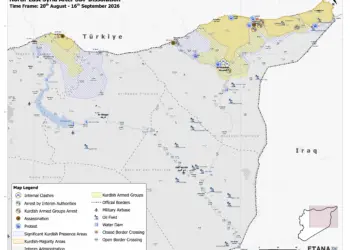
Despite continued setbacks and signs of local resistance, the last month saw tangible steps towards incorporating Syrian Democratic Forces (SDF) units into the Syrian army. One of the most concrete areas of progress has been the near-final resolution of the detainee file in the north-east: multiple large-scale prisoner exchanges took place throughout April, combined with the transfer of detention facilities and joint administration of key prisons. Despite tangible signs of progress, overt resistance to the integration roadmap has grown louder within some rejectionist factions of the SDF, overwhelmingly centered in Hasakeh province. The widening gap between developments on the ground and political acceptance of these changes raises the risk of serious political rifts within the SDF or even conflict between the interim government and Kurdish splinter groups, although any future conflagration is likely to be limited and highly local.
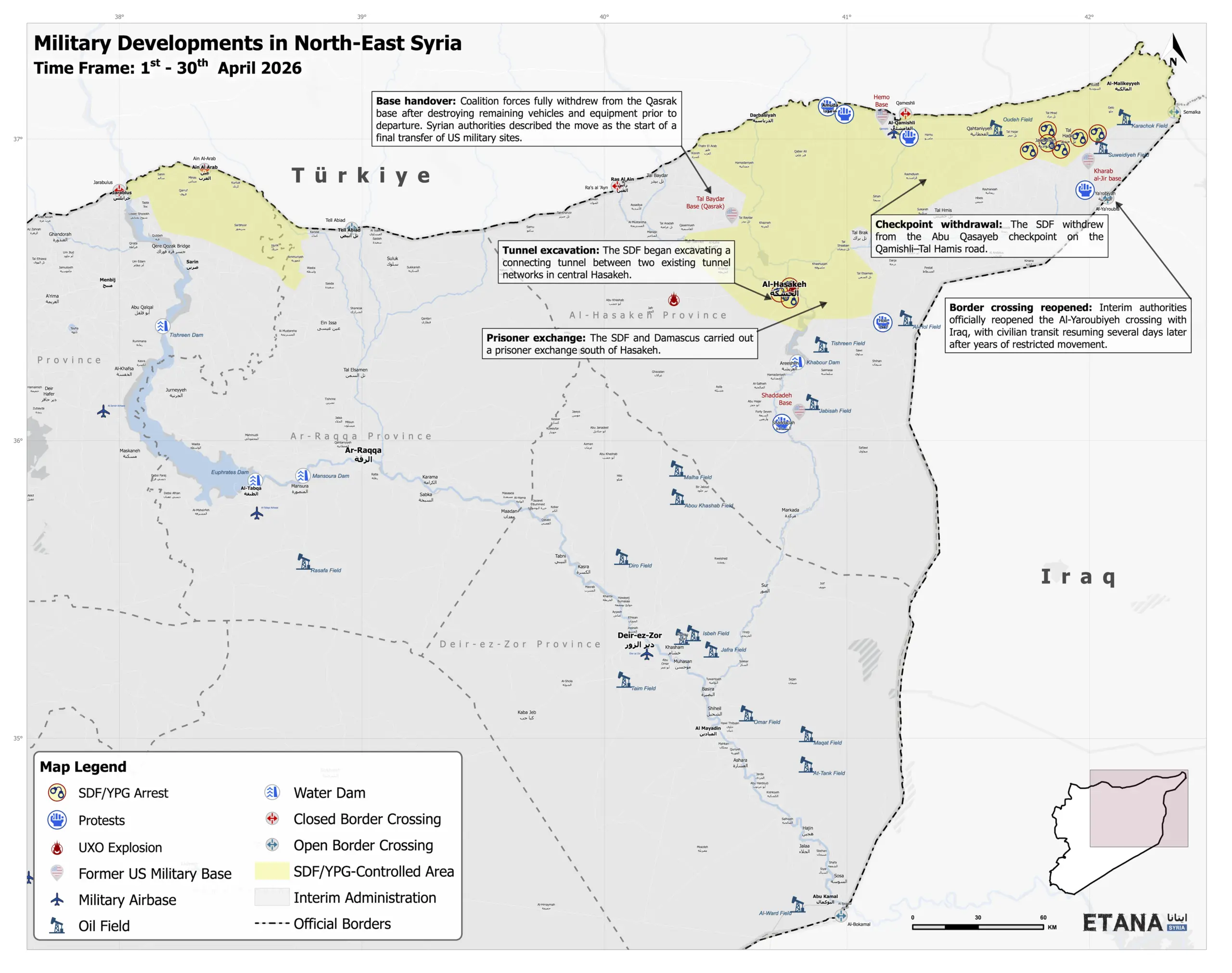
Damascus-SDF Security Integration
A significant milestone has been reached in recent weeks with the formal incorporation of Syrian Democratic Forces (SDF) units into Syrian military structures, overcoming months of tense and longstanding resistance from factions on both sides. So far, the roadmap has yielded the establishment of integrated brigades under the 60th and 72nd Divisions, with reports that at least four brigades have been merged into the Syrian army. Additionally, joint trainings of brigades in Damacus and the initiation of salary payments through the interim Ministry of Defense underscore this shift from conceptual integration to concrete progress. While new thresholds have clearly been crossed, the process is now transitioning into a more complex phase of restructuring and resolving stickier finer details.
Progress on the detainee file remains one of the most hopeful areas of the integration roadmap, with multiple large-scale prisoner exchanges conducted in April that culminated in the near-complete transfer of SDF detention facilities to the interim Ministry of Interior by late April. Joint or transitional administration of key facilities—including the Ghuweiran and Alaya prisons—alongside high-level inspections by interim judicial authorities, reflects progress towards standardizing detention systems in Syria under state control and demonstrating cooperation with partner-states on counter-terrorism. Despite vaguely contradictory statements by Hasakeh governor Noureddine Ahmad last month, in which he described plans for a partially integrated, hybrid prison management model, more recent developments suggest convergence toward a unified model, marking the closure of a major security integration file.
In addition to progress at the level of military structural reform, a series of coordinated handovers has also significantly expanded the interim government’s operational presence across north-east Syria. Parallel developments—such as the SDF’s dismantling of barriers around former government buildings in Hasakeh and agreements to transfer judicial and administrative facilities—indicate a broad-based effort to reestablish physical state authority across both military and civilian domains.
Despite measurable progress in formal integration, recurring disputes over state symbolism—particularly the raising and removal of Syrian state flags in Hasakeh and Qamishli—illustrate enduring resistance at the local level among activists and large swathes of the public. These incidents, often followed by partial reversals through Asayish intervention, highlight the palpable mistrust and sensitivity around questions of sovereignty and Kurdish identity. Additionally, reports of ongoing drone interceptions, cross-border fire incidents involving Turkish forces and aerial attacks originating from Iraqi territory are some of the external pressures shaping the environment within which negotiations are taking place. Simultaneously, longstanding security risks from the conflict, including landmines and unexploded ordinances, continue to menace large swathes of the north-east, resulting in regular casualties among civilians and troops alike.
Political Dynamics & Challenges
While institutional integration has advanced, political resistance within the remains of the Self Administration’s bureaucracy has mirrored that within the military ranks of some SDF leadership factions, growing more pronounced in recent weeks. Statements by senior figures emphasizing the preservation of Kurdish political structures, the absence of a fixed integration timeline and the rejection of full centralization have grown louder: senior SDF figure Aldar Khalil accused Damascus of pursuing integration through a “centralized, authority-maximizing approach,” stating that implementation of the January agreement remained limited. His statements coincided with those of YPJ spokesperson Roxana Muhammad, who rejected any attempt to downgrade the force to a non-military role and insisted on continued armed status until formal recognition of the YPG is secured from Damascus. It is unclear if the timing of these statements was coordinated for maximum impact in the face of accelerating trends towards integration.
Economic Integration & Oil Production
Alongside political and security institutions, the transfer of key assets—including border crossings such as Semalkah and Al-Yaroubiyeh as well as energy infrastructure—and the gradual implementation of state customs procedures, are key signs of progress taking place on a parallel track of economic integration in recent weeks. These measures are certain to enhance Damascus’ leverage over local actors while embedding state authority within the mechanics of everyday governance.
Damascus has moved steadily to consolidate nominal authority over north-east Syria’s oil sector following the gradual erosion of SDF control, with operations now largely managed through the Syrian Petroleum Company and affiliated entities such as Al-Furat Company and the newly established Petroleum Services Support Company (PPS). The transition has centered on reactivating strategic fields, particularly Al-Omar in Deir Ezzor and Rumeilan in Hasakeh. Despite this formal reassertion of state control, operational authority on the ground remains fragmented and at times opaque, with revenue flows highly centralized in Damascus and subject to minimal oversight or transparency.
Despite oil’s strategic importance, severe infrastructure degradation continues to plague the sector and constrain its prospects in the near term. Improvised extraction methods, poor maintenance and the depletion of technical expertise have significantly damaged production capacity, even as relatively viable infrastructure at major fields offers the potential for rehabilitation in the long term. Oil revenues have thus far failed to generate visible improvements in services, employment or living conditions across Raqqa and Deir Ezzor, increasing the risk that the sector will continue to function primarily as a driver of elite competition, corruption and local resentment rather than economic recovery.