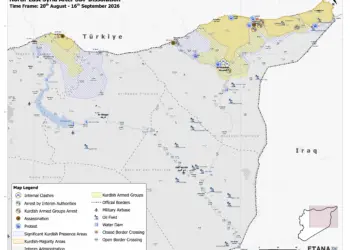
While military integration talks between the Syrian Democratic Forces (SDF) and Damascus have remained constructive, translating paper agreements into tangible implementation is likely to provoke significant local reactions. This dynamic has already been reflected in Arab protests in Kobane, Ras al-Ain and Suluk, opposing the incorporation of SDF-affiliated personnel into local security structures. So far the process has been characterized by modest, practical gains—most notably on the detainee file—set against slower, more tentative engagement on the broader and more contentious questions shaping the next phase of the process. Against this backdrop, Arab-Kurdish divisions also appear to be widening in north-east Syria, with a sharp escalation in intercommunal violence following the circulation of a video showing a Kobane resident publicly removing a Syrian flag.
Within the civilian institutions of the Self Administration, the integration process generated widespread uncertainty among employees. This has contributed to declining focus, reduced institutional commitment and a perceptible deterioration in service delivery. At the core of these concerns is the question of formal recognition by interim authorities, seen as essential to safeguarding employment and salaries. More broadly, this anxiety underscores an emerging reality in north-east Syria: control over the state payroll is increasingly the decisive factor in securing the loyalty of public sector employees across both systems. While these emerging faultlines could provide the grounds for more serious disagreements in the long-term, negotiations and piecemeal integration steps are expected to continue on their current course for the time being.
Military Integration
While interim authorities have broadly adhered to the January roadmap and integration framework—maintaining dialogue on military coordination and appointing a number of qualified, SDF-affiliated Kurdish figures to administrative positions—implementation has been inconsistent. The deep-seated unpopularity of some measures within local Arab and Kurdish communities, alongside recurring allegations of ideological favoritism and a lack of transparency in the selection of appointees have compounded already high levels of mutual distrust, with both sides continuing to question the long-term intentions and strategic objectives of the other. These dynamics and entrenched disagreements have largely yielded a piecemeal approach to integration, characterized by pragmatic, multi-tiered processes that have seen some service sector advancements, while military and defense mergers have seen little tangible progress since early February.
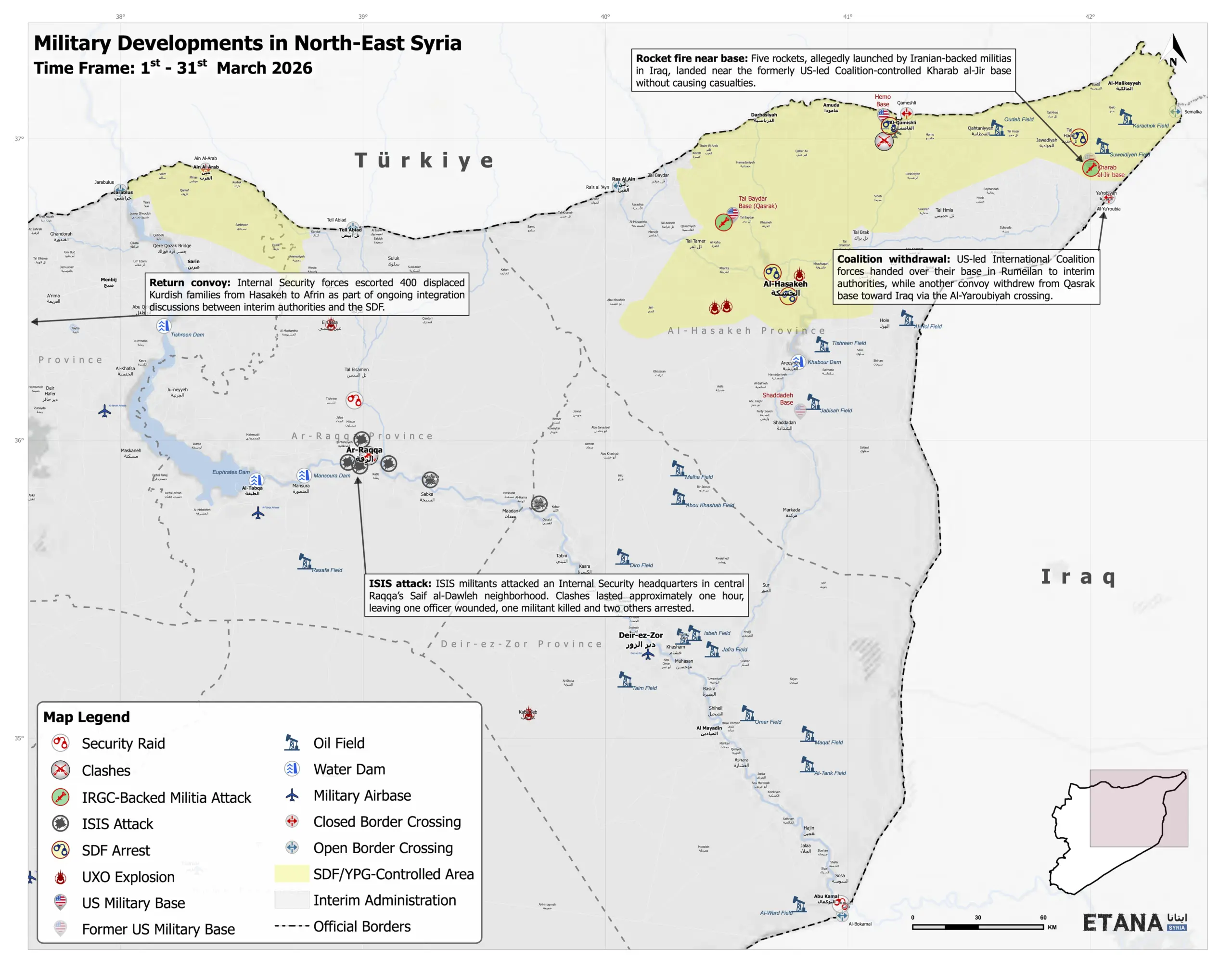
Over the past two months, military integration talks between interim officials and the SDF have advanced cautiously, shifting from broad political understandings to more technical discussions around implementation. However, little progress has been made on the ground beyond discussions. The core issues under negotiation include the structure of command and control, the status and ranking of SDF officers within the Syrian army, and the future of security forces such as the Asayish. While Damascus continues to push for centralized absorption of SDF units into existing military hierarchies, the SDF has sought to preserve elements of its autonomous command framework. Meanwhile, US-led International Coalition forces handed over their base in Rumeilan to interim authorities; another coalition convoy withdrew from Qasrak base toward Iraq in mid-March.
One tangible sign of progress in security negotiations has been the successive rounds of prisoner swaps between the SDF and interim authorities in recent months. Conducted primarily in Hasakeh, these swaps have proceeded in multiple phased batches. In mid-March, both sides exchanged approximately 300 detainees each, with subsequent releases continuing into late March as part of a coordinated effort to close the detainee file. However, even the concrete progress of these swaps has drawn anger and protests from both sides. Arabs in Deir Ezzor and Hasakeh have accused the SDF of adding the names of Arab detainees to lists it is providing of ISIS members to be transferred to Iraq. On the other side, Kurds have accused the government of releasing primarily Arab SDF detainees, spurring sit-ins and public protests.
Security Developments
Intercommunal tensions in north-east Syria escalated sharply following the circulation of a video depicting a resident in Kobane removing the Syrian flag, compounded by retaliatory attacks against Kurdish residents in Aleppo in late March. The incident triggered a series of reciprocal responses, including attacks by Kurdish actors on an interim government security point at Qamishli International Airport, alongside additional gatherings near security positions in Hasakeh, where SDF intervention helped prevent further escalation. On the ground, violence intensified with indiscriminate gunfire targeting the Arab-majority Tayy neighborhood in Qamishli, protests in government-held areas accompanied by tribal mobilization, and incidents of abuse at SDF checkpoints. Armed actors also conducted shows of force in Arab neighborhoods, firing into the air and chanting inflammatory slogans. In response, officials issued calls for restraint and warned against sectarian escalation. A temporary overnight curfew was imposed as authorities sought to contain the unrest.
Political Integration & Developments
Significant progress has been made in some crucial, but less politically charged sectors, such as healthcare. In late February, interim authorities announced a wave of appointments to take over Hasakeh’s health sector, including Dr. Khaled al-Khaled, an Arab former UNHCR employee in Hasakeh who is considered a neutral civilian, as provincial health director. Al-Khaled subsequently appointed 12 administrators to manage the departments, offices and divisions of the health directorate in Hasakeh, all of Kurdish origin with previous experience working for the Health Authority. A decision was then issued in early March to integrate healthcare workers in Deir Ezzor, Hasakeh and Raqqa—previously employed under SDF institutions—into the interim Ministry of Health. Despite the early success of this merger, it has largely proven to be an outlier in terms of practical progress, which has otherwise stalled in other areas.
On the education file, Damascus appointed Faisal al-Ali as assistant education director in Hasakeh, appearing to give some leeway in a sector considered particularly sensitive for the SDF by opting not to appoint an HTS insider. Al-Ali previously headed the Basic Education Department under the former regime. The appointment suggests Damascus may be positioning him as the de facto authority, while the current SDF-affiliated director, Adnan al-Bari, remains a nominal, largely symbolic figure in the administration.
Under regulations introduced by the interim government, all NGOs and civil society organizations are now required to undergo a new licensing process through the interim Ministry of Social Affairs and Labor, which requires organizations to sign coordination protocols with provincial political and international cooperation offices. As of now, no organization has completed these procedures, effectively halting all civil society activity in north-east Syria. Damascus appears to be centralizing control over funding flows under the guise of anti-corruption.