For months, Suwayda has been locked in stalemate: political talks have gone nowhere; neither side has proven willing or able to fundamentally alter the military situation on the ground. As such, the most significant political shift followed seemingly innocuous appointments of local officials that reflect the ongoing tussle for legitimacy and authority between the interim administration and local Druze authorities aligned with Sheikh Hikmat al-Hijri. The most recent incident, where armed groups stormed the Education Directorate in protest against interim government-led appointments, prompting backlash from staff and local residents, indicates that continued siege-like conditions and deteriorating socio-economic dynamics in Suwayda are noticeably destabilizing Sheikh al-Hijri’s legitimacy within the province—one of the government’s main aims after the failure of the offensive on Suwayda last year. This will likely remain the status quo for the time being, with interim authorities attempting to incrementally chip away at al-Hijri’s influence while keeping the province in a state of socio-economic uncertainty.
Political Stand-Off in Local Administration
Starting in early April, Suwayda governor Mustafa al-Bakour oversaw the first in a series of appointments to local administration positions within Suwayda—usually based on loyalty to the interim administration or connections with al-Bakour himself. For example, the interim Ministry of Education appointed Safwan Ballan as director of education in Suwayda. The interim Ministry of Social Affairs and Labor also appointed Amani Merhej Zeitouneh as director in Suwayda; Zeitouneh previously served as the deputy director in the province.
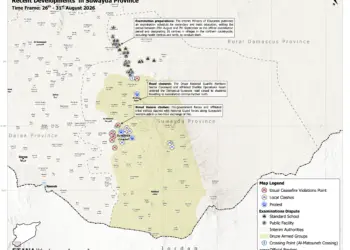
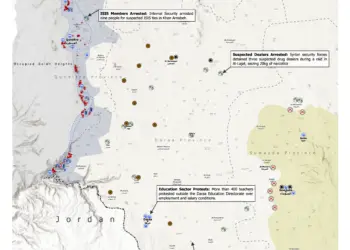
Responding to news of the appointment of Ballan as director of education, an armed group stormed the directorate’s building in central Suwayda city and fired shots in the air, preventing employees from entering the building. Some media outlets reported that the armed group belonged to the security office of the National Guard, a claim that ETANA cannot independently verify. ETANA’s reporting confirmed a small handful of individual members of the National Guard participated in the incident at the directorate in their personal capacity and are currently being detained for their involvement. Backlash was swift: Ballan announced that he would withdraw from his position in the wake of the incident.
The following day, directorate employees went on strike or staged protests in different areas of the province; teachers and directorate employees in Shahba issued a statement demanding better protections for staff and calling for a two-day suspension of classes until these demands were met; demonstrations were also reported in Um al-Ruman and other areas. The Druze-led Internal Security Command summoned several individuals for questioning regarding the incident. Regardless of who ordered the attack on the directorate, the incident played into the hands of interim authorities who see Sheikh al-Hijri’s parallel governance in Suwayda as illegitimate and “separatist.” Pro-government Druze figure Laith al-Balous called the attack a “serious violation” that was “in service of agendas that have nothing to do with the interests of Suwayda’s residents.”
This coincided with growing calls within Suwayda against the Higher Legal Committee, the political/civil governance body established by Sheikh al-Hijri in August last year. A day before the storming of the Education Directorate, protesters in Al-Karameh Square demanded the committee’s dissolution amid worsening socio-economic conditions inside the province. Two days later, Sheikh al-Hijri then issued a statement ordering the dissolution of the Higher Legal Committee. In its place, the statement clarified, judge Fayez Murshid had been tasked with forming an “Administrative Council in Jabal Bashan” that would “serve…primarily [as] a crisis management body.” Although the Higher Legal Committee had exceeded the original six-month mandate under which it was established, the move reflects a tactical retreat by Sheikh al-Hijri and the Druze leadership around him in response to public outcry.
Ceasefire violations
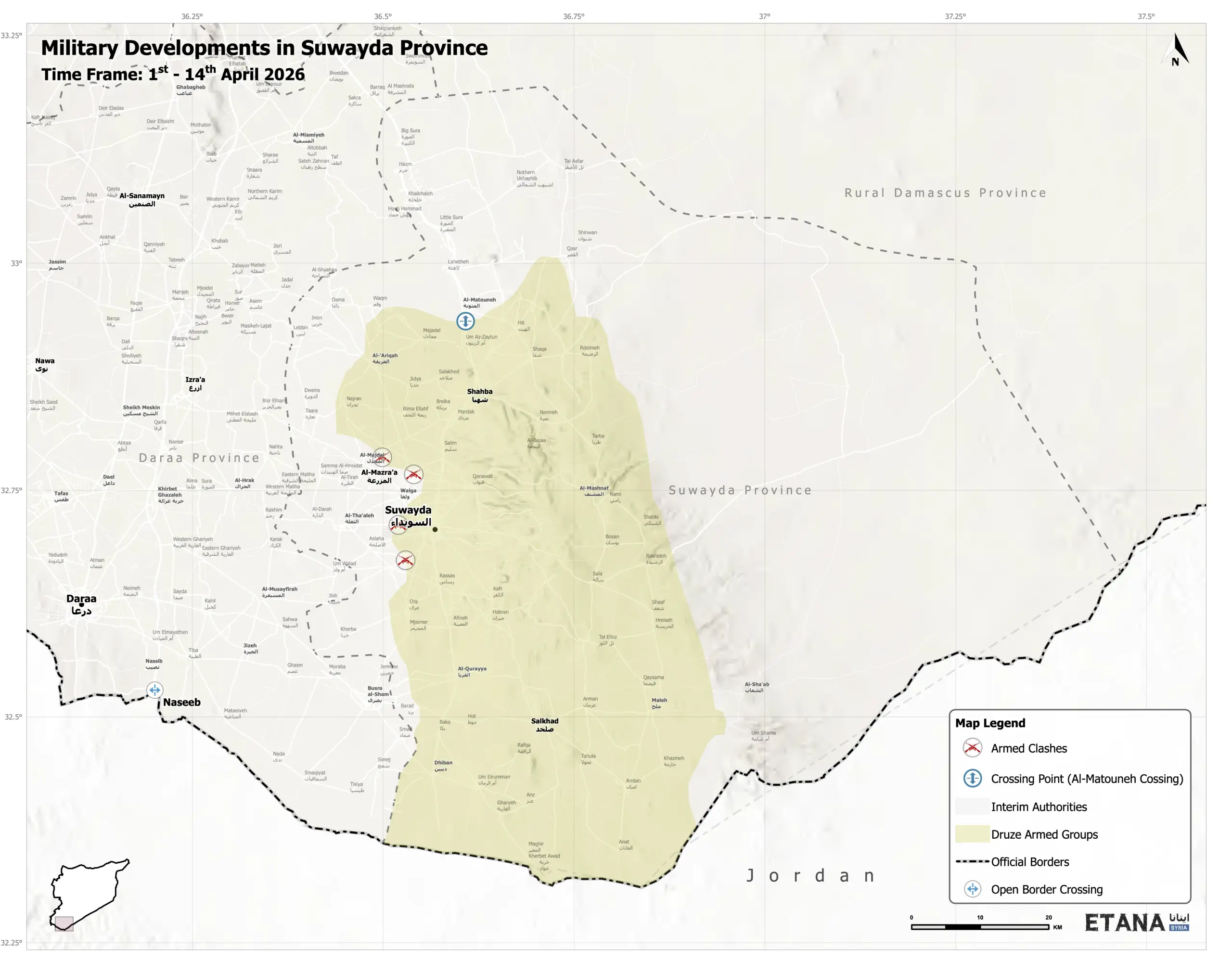
ETANA documented eight ceasefire violations since the beginning of April, including: five attacks by pro-government forces and three counter-attacks by the National Guard forces. All of these were localized, minor clashes and did not escalate into more significant violence akin to clashes last month that saw sustained fighting and Israeli strikes against pro-government forces.
Political & Humanitarian Developments
Flour supplies ran out in Suwayda at the beginning of April, forcing bakeries across the province to close for two days. The supply shortage was reportedly because the province was waiting for finalization of a contract with the UN World Food Program, which has provided flour to Suwayda since August last year. Residents were instead forced to rely on private bakeries where a one-kilo bundle costs 10,000 Syrian pounds apiece. The first subsidized flour shipment in days then arrived to Suwayda a week later. As with flour supplies and bread distribution, Suwayda’s fuel supply remains contingent on external shipments. ETANA documented three separate fuel shipments since the beginning of April.