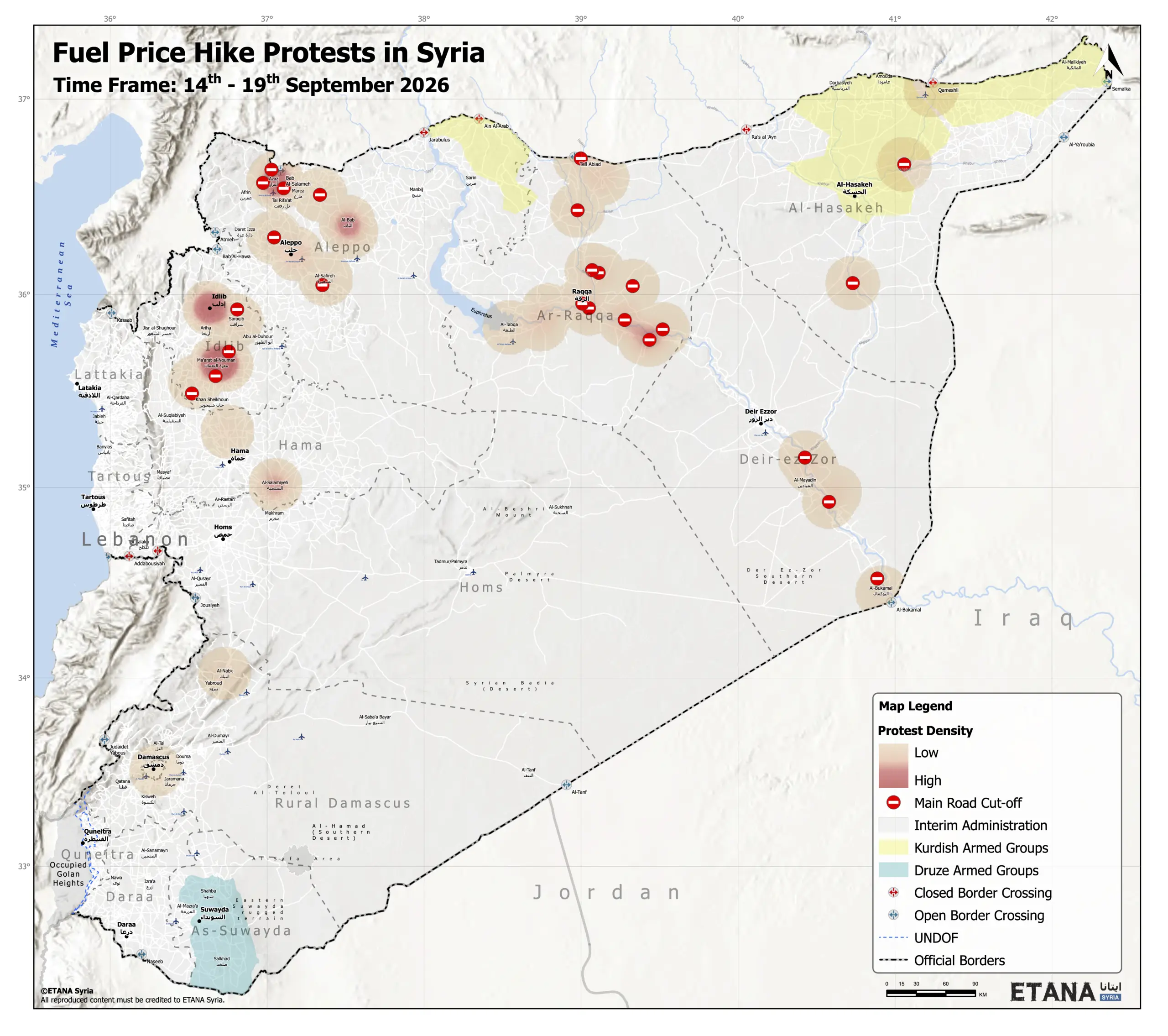
On 13th September, interim authorities introduced a new pricing bulletin raising prices for diesel by 40%, 90-octane petrol by 26%, 95-octane petrol by 28%, and household gas by 8.5%. Public anger was swift. Between 13th and 17th September, ETANA documented as many as 42 protests, road closures and sit-ins across eight provinces—Aleppo, Damascus, Deir Ezzor, Hama, Hasakeh, Idlib, Raqqa and Rural Damascus—in response to price hikes, although the total number is likely higher. Central demands from protesters were consistent across affected regions: the reversal or reduction of fuel prices; higher wages; protection of purchasing power; and, increasingly, accountability for perceived economic mismanagement by interim authorities. The protest movement represents a significant test for the nearly two-year-old interim government, as economic grievances have spread across geographically and politically diverse parts of the country—including areas only recently brought under Damascus’ control.
Background
In mid-September, the interim government introduced a new pricing bulletin that raised diesel by 40%, 90-octane petrol by 26%, 95-octane petrol by 28%, and household gas by 8.5%. Together, these represent the highest fuel prices in Syria’s history. The government justified the increases primarily by citing a $1 billion debt owed by the interim Energy Ministry to the Finance Ministry, low electricity revenue collection outside Damascus, Aleppo and Latakia, and the global rise in oil prices. It also linked the increase to the temporary need for additional fuel imports while the Baniyas refinery undergoes a major overhaul. The Energy Ministry described the increases as temporary.
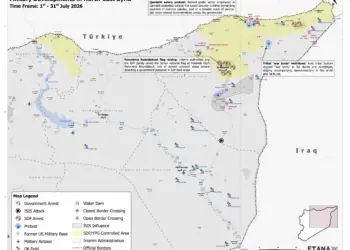
While ordinary motorists were predictably hit hard, the economic impacts of these price hikes extends well beyond motorists. Estimates indicate that transport fares rose by up to 25% and agricultural and other supply-chain costs by up to 20%, with fuel particularly consequential in agricultural areas because diesel powers irrigation, farm machinery and transport. In the ensuing days, protests spread across several Syrian governorates, with the strongest concentration in the north-west, especially in Idlib, and across the north-east. Open-source monitoring and field reporting by ETANA documented as many as 42 protests, road closures and sit-ins across eight provinces: Aleppo, Damascus, Deir Ezzor, Hama, Hasakeh, Idlib, Raqqa and Rural Damascus.
Protests & Protest Dynamics
Although triggered by austerity policies, the protests reflect mounting economic and governance grievances directed at interim authorities rather than a single-issue price dispute. Monetary instability, high living costs, weak public services, perceived waste and corruption and a widening gap between official salaries and ordinary wages all contributed to the public backlash. Although the policy that caused recent protests was national, various localized factors are driving socio-economic grievances in different areas of the country. Central demands from protesters were consistent across affected regions: the reversal or reduction of fuel prices; higher wages; protection of purchasing power; and, increasingly, accountability for perceived economic mismanagement by interim authorities.
In Idlib grievances have been compounded by capital flight, declining humanitarian and medical support and the redistribution of state and aid resources towards Damascus, Aleppo and other governorates. The reopening of roads (once blocked by regime-opposition frontlines) and shifting governmental focus have contributed to an administrative vacuum and a renewed perception of Idlib as marginalized—akin to its position before 2011 but in stark contrast to its importance when under Hay’at Tahrir al-Sham (HTS) and the Syrian Salvation Government. Protesters in Idlib demanded reversal of the price increase and linked the measure to worsening poverty, weak services and perceived inequality.
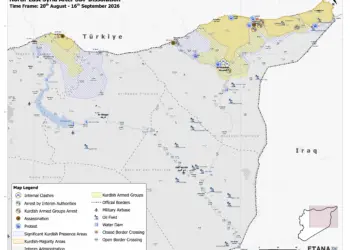
ETANA documented major protest clusters in Idlib and north-east Syria, including both government-controlled areas of the north-east and Kurdish-held areas in Hasakeh. In Hasakeh, ETANA recorded approximately 12 protest sites in government-controlled areas and 25 in Kurdish-controlled areas. In Kurdish-controlled Hasakah, protests were generally more organized; protests in Tal Tamr were notable for repeatedly blocking the M4 international highway and oil tankers passing along it.
Government Responses
With protests continuing to spread, interim Energy Minister Muhammad al-Bashir announced that interim authorities would offer cheaper diesel for heating, agriculture and industry on 17th September. Al-Bashir told reporters that diesel would be sold at three different prices—115, 150 and 175 Syrian pounds respectively—depending on its intended use. Ultimately, interim authorities can only avoid widespread unrest if they can produce tangible improvements in living conditions.
The conduct of security forces was notable for its relative restraint. Security personnel in Idlib largely refrained from dispersing protesters, while in the north-east, authorities avoided forcibly clearing roadblocks and instead relied on local intermediaries to mediate. Still, scattered dispersals and detentions occurred. Escorts accompanying a government convoy reportedly fired into the air in Deir Ezzor’s Al-Buhamad, while in rural Aleppo’s Azaz, protesters and security personnel exchanged stones before security forces withdrew. A peaceful protest outside the People’s Assembly in central Damascus resulted in the detention of four people who were eventually released.