Despite months of halting progress, local resistance and entrenched factional interests, the Syrian Democratic Forces’ (SDF) integration process appears to be gaining momentum. Regular unaccompanied Internal Security vehicles have begun patrolling the city of Hasakeh for the first time, representing a step towards normalization of interim government forces in the region and trust-building. This relatively smooth transfer of political and security institutions to centralized government control is largely attributable to the SDF’s own pronounced weakness. Its actual number of fighters appears to be less than initially believed and many have now been partially or fully absorbed into the state security apparatus. At the same time, the fate of the Women’s Protection Units (YPJ) remains unknown, with YPJ leadership adamantly against folding the group into a mixed force.
Damascus-SDF Security Integration
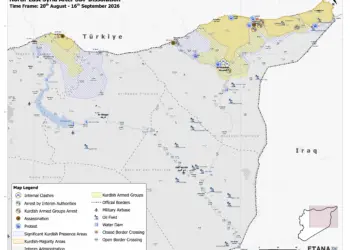
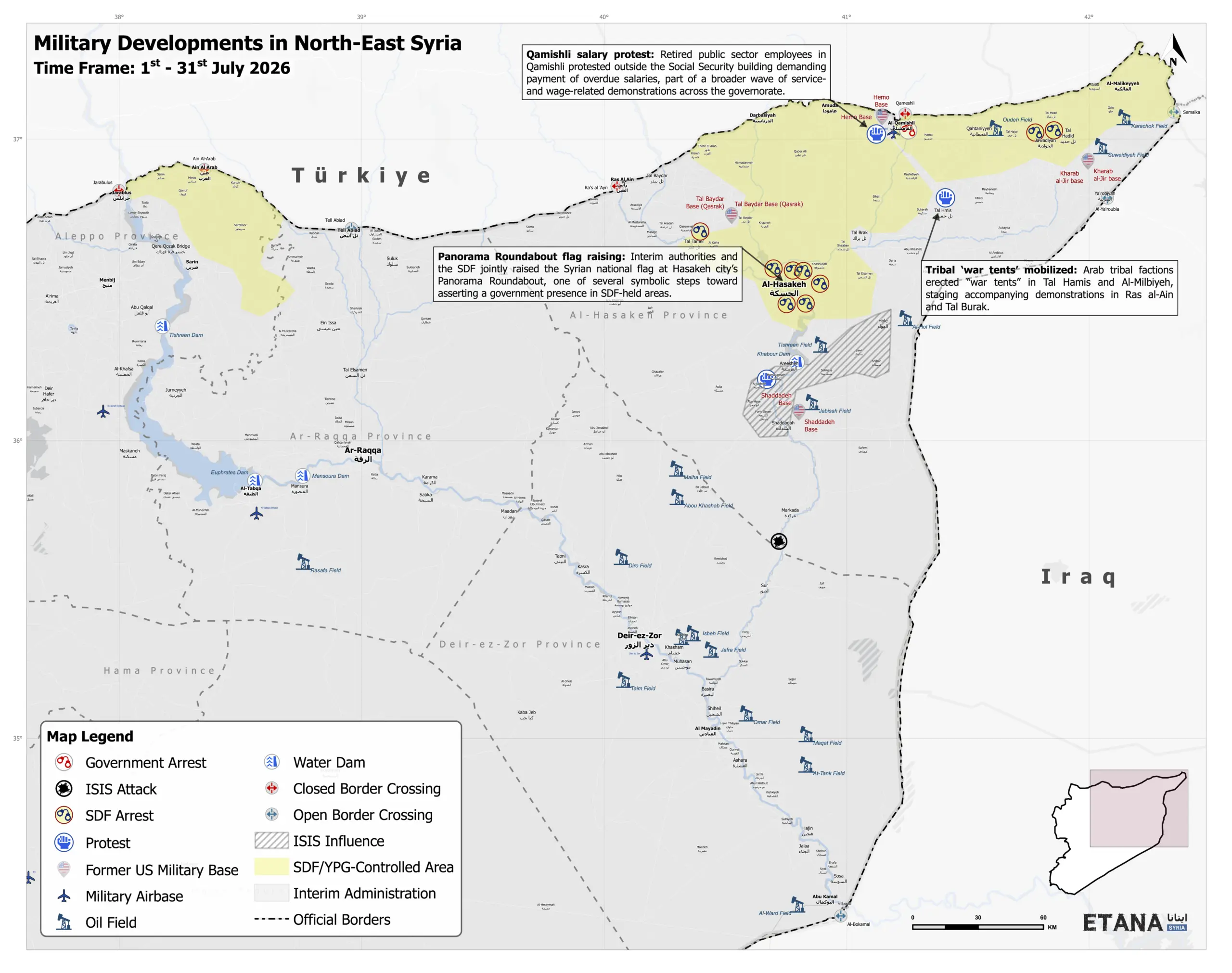
The formal integration process between Damascus and the Syrian Democratic Forces (SDF) continued to move forward on several key military and administrative fronts through July. In a symbolically significant milestone, in late July Internal Security vehicles patrolled several main streets in Hasakeh city without SDF accompaniment, the first time this had taken place since the integration agreement reached earlier in the year. The move was accompanied by an increasingly optimistic narrative from pro-government media outlets regarding the SDF’s imminent dissolution. The interim Ministry of Interior also completed core administrative procedures for absorbing the Sutoro forces—originally a Christian, specifically Syriac, protection force raised under the supervision of the People’s Protection Units (YPG)—into the Internal Security apparatus.
The future of the Women’s Protection Units (YPJ) continued to dominate the more contentious edges of the integration file, with YPJ commander Rohlat Afrin reiterating that the group’s central demand is to preserve its full institutional distinctiveness within the Syrian army rather than being folded into a mixed force. On the other side, the Self Administration’s representative in Damascus, Abdelkarim Omar, stated that the Syrian army has formally proposed integrating the YPJ into the interim Ministry of Interior as a specialized counter-terrorism unit and is awaiting a presidential decision on the matter.
Despite continued progress, senior SDF leaders continued to signal both commitment to, and unresolved tension within, the integration process. Prominent Kurdish politician Ilham Ahmad criticized the interim government’s weak female representation and persistently centralized mindset, calling for a new national constitution guaranteeing communal rights and a Kurdish role in Syria’s future, while separately floating broad agreement on changing the name of the “Syrian Arab Republic” to the “Syrian Republic.”
SDF commander Mazloum Abdi affirmed that the agreements with Damascus would entail sweeping administrative changes and that both the SDF and Self Administration would ultimately be absorbed into the new Syrian state. Sihanouk Dibo, for his part, stated that the Self Administration’s dissolution is contingent on completion of the integration process and would not necessarily mean the Self Administration’s abolition outright—it could instead transition into a Syrian political party—and stressed that the integration agreement itself set no fixed deadline for ending the political entity or dissolving the SDF.
Security Developments
Opposition to the pace and terms of SDF integration briefly escalated into overt tribal mobilization. Following two days of inaccurate media reports about clashes between tribal forces and the SDF in eastern Hasakeh, Arab tribesmen erected “war tents”—traditional mobilization points for tribal fighters—in Tal Hamis and Al-Milbiyeh, accompanied by demonstrations in Ras al-Ain and Tal Burak, in a coordinated signal of potential action against the SDF and the integration process’ progress. The tents were ultimately dismantled on 25th July following government outreach to tribal leaders, with assurances of a greater government security presence in SDF-held areas to follow.
The SDF sustained a steady campaign of arrests against individuals accused of cooperating with rival “terrorist entities”—variously identified as the interim government or Türkiye—concentrated heavily among Arab tribal communities. Targets included dozens of people, among them civilians. The pattern suggests these arrests are directed less at formal state institutions than at a broader set of actors operating within Syria’s evolving security apparatus.
Political & Humanitarian Developments
The Hasakeh delegation recently appointed by the Presidency to join the People’s Assembly comprised a religiously and politically mixed slate, including Assyrian Democratic Organization figure Kibrael Moshe Koria and Kurdish National Council figure Abdelhakim Bashar. An 11-member interim executive council for the governorate was subsequently established, comprising four Arabs, six Kurds and one Christian and chaired by the Kurdish governor. In parallel to military integration efforts, judicial integration has also progressed steadily. Fifteen judges from the Self Administration underwent interviews with a committee affiliated with the Ministry of Justice, with 35 more expected to follow before procedures begin to reopen courts in Hasakeh and Qamishli.
The Self Administration’s Health Authority replaced an official government sign on a Hasakeh health institute with one identifying it as a subsidiary of “Rojava University,” prompting deputy governor al-Hilali to state publicly that a new name reflecting Hasakeh’s population would be adopted for the university, that Arabic and English would remain its primary languages of instruction, and that a Kurdish-language course—unprecedented in Syria—would be introduced alongside the national curriculum. However, language remains a major unresolved sticking point, with these measures falling short of Self Administration demands for full Kurdish medium education.