The Damascus–Suwayda relationship remains characterized by mutual distrust, with Damascus seeking to reassert administrative and security authority while local factions continue to resist measures perceived as extending government control. This was most recently exemplified in the examination dispute, in which Damascus authorities sought to hold exams for Suwayda students in government-controlled northern Suwayda—a move that met resistance from the National Guard and some Suwayda residents. Ultimately, of approximately 1,700 students registered across the two certificate tracks, just 130 students from Suwayda actually sat for their exams.
The examination dispute illustrates how relatively limited administrative issues can rapidly become security confrontations, particularly where the National Guard retains effective control over movement and local coercive capacity. In the short term, a return to sustained large-scale conflict appears less likely than continued low-level engagements, localized exchanges and periodic mobilisation, as both sides have incentives to avoid the costs of another major confrontation.
The interim government’s consolidation of control elsewhere in Syria—including the recent dissolution of the Syrian Democratic Forces (SDF)—may increase pressure on Damascus to address the remaining territorial challenge posed by Suwayda, although the costs of coercive action and the potential for external intervention remain important constraints. Absent of meaningful political dialogue and agreement on local security and governance arrangements, the most likely trajectory is therefore a prolonged and unstable ceasefire, punctuated by localized violence and periodic crises, rather than either a definitive settlement or immediate renewed war.
Dispute Over Examinations
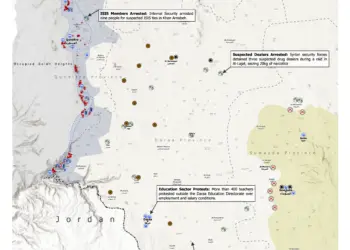
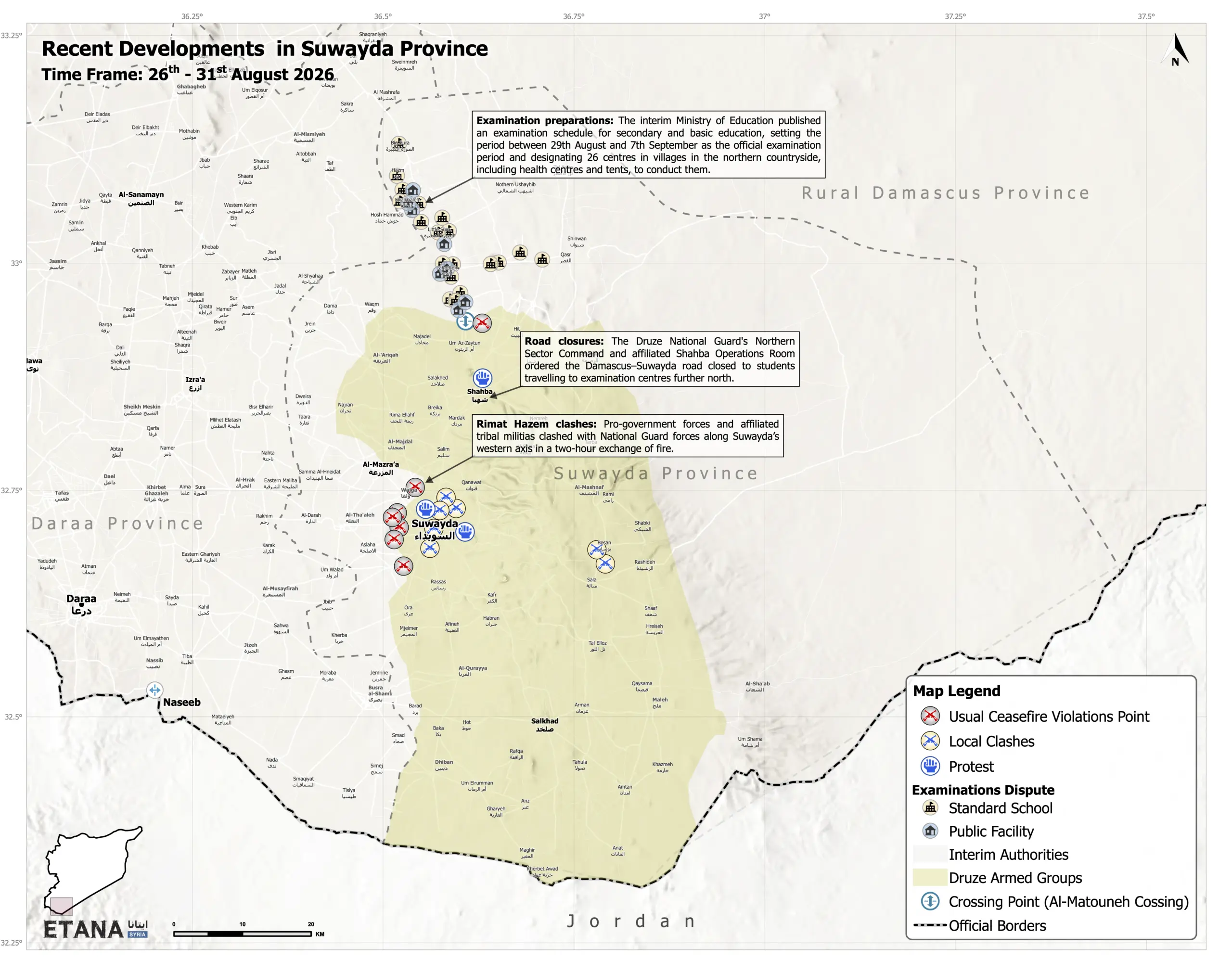
In late August, interim President Ahmed al-Shara’a issued Decree 163/2026 mandating an exceptional examination session for Suwayda students at intermediate and secondary levels, although it did not specify detailed procedures. Suwayda governor Mustafa al-Bakour subsequently issued a circular stating that the exams would be held in the government-controlled northern countryside of Suwayda. The following day, the interim Ministry of Education published an examination schedule for secondary and basic education, setting the period between 29th August and 7th September as the official examination period and designating 26 centres in villages in the northern countryside, including health centres and tents, to conduct them. These centres had a combined capacity of approximately 3,300 students, compared with roughly 13,000 students across Suwayda’s secondary and basic education streams.
Druze officials and civilians quickly attempted to push back against official exam preparations, particularly the fact that exams would be conducted in the government-controlled north. A delegation from Suwayda’s Druze-led Education Directorate met with al-Bakour to raise logistical and security obstacles facing students; that same day al-Bakour refused these appeals while the minister of education visited Al-Sawrah al-Saghira and inspected preparations at examination centres. Days later, students and their relatives protested in Shahba demanding that examinations be held in “safe areas” within Suwayda proper.
The Druze National Guard ordered the Damascus–Suwayda road closed to students travelling to examination centres further north. Grounds for an internal dispute were set when a group of students’ families issued a counter-statement urging students to proceed and calling for the road to be reopened, amid fears of clashes between residents and National Guard forces. Students either hoped to travel to Damascus where they could then reach northern Suwayda during the examination period or to travel directly from their areas of the province on to northern Suwayda on the day of their exams.
In the days leading up to the official examination period, Druze security forces started preventing onward travel by students from Suwayda. A checkpoint on the Damascus–Suwayda road prevented several secondary and ninth-grade students from travelling to Damascus to stay there during the examination period and turned them back towards Suwayda. Several villages and towns nevertheless organised transport to examination centres in government-controlled areas. On 28th August the National Guard established a checkpoint at the northern entrance to Suwayda city to inspect buses and prevent anyone aged between 15 and 18 from passing. Later that same day, the National Guard’s Shahba City Operations Room confirmed that the Damascus–Suwayda road would remain closed to student transport to the northern countryside and warned against using buses.
Despite the security measures and warnings, several schools nevertheless prepared transport to take students to the examinations, with students planning to gather in Suwayda city before departing in a single convoy. Suwayda’s Education Directorate, school principals and civil society activists also worked to organise transport and conducted a headcount of participating students; approximately 1,700 students across the governorate were ultimately counted across the two certificate tracks. The following day, buses carrying students from across the governorate attempted to reach central Suwayda to join a convoy to the examination centres, but armed groups and local residents blocked roads at several locations. Hundreds of students and family members gathered at the Stadium Roundabout, while checkpoints at Al-Anqoud Roundabout and elsewhere prevented buses from reaching them; the students remained there until 8am before returning home. A Shahba Operations Room checkpoint also prevented Directorate of Education delegates and examination proctors from reaching the centres. Ultimately, just 130 students from Suwayda succeeded in taking their exams.
Ceasefire Violations
Pro-government forces and affiliated tribal militias stationed in Rimat Hazem violated the ceasefire by targeting National Guard positions on 29th August. National Guard forces in Suwayda’s western axis responded with medium machine-gun fire, resulting in an intermittent exchange lasting more than two hours. Pro-government forces also used mortars and bursts of 23mm machine-gun fire over western Suwayda neighbourhoods; no significant casualties were reported.
The area around Rimat Hazem saw another bout of clashes days later when pro-government forces and affiliated tribal militias deployed snipers to attack National Guard vehicles. After the National Guard returned fire, pro-government forces fired machine guns and indiscriminately shelled areas of western Suwayda city; the National Guard also deployed drones targeting pro-government forces near Walgha and Tal Hadid. Clashes continued past midnight with no change in control lines on the ground.