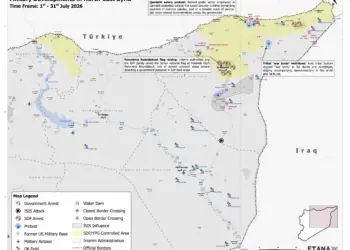
In late August, Syrian Democratic Forces (SDF) commander Mazloum Abdi announced the dissolution of the SDF and the end of their mission as an independent military entity in north-east Syria. Despite the suddenness of the announcement, the statement should be read as acknowledging a fundamental, but largely gradual, shift that was already well underway. The integration process in the north-east increasingly reflects a pragmatic accommodation between two weakened sides, with the former SDF accepting concessions while seeking to preserve influence and localized nodes of control where it retains leverage against an overstretched central government facing a public finance crisis. While important questions over the distribution of local authority remain, both sides have an overwhelming interest in managing the transition without a return to military confrontation.
The process is expected to remain a gradual, negotiated redistribution of authority, one in which Damascus steadily expands its formal institutional and security footprint even as Kurdish authorities work to hold onto localized control and political influence, particularly in Kurdish-majority areas. While the SDF has dissolved as a unified, independent governing authority, local formations remain largely intact and an immediate handover of Kurdish strongholds such as Hasakeh to troops from elsewhere in Syria is highly unlikely. The integration process’ remaining phase will likely unfold incrementally, as the two sides hash out the final division of administrative, security and political authority across the north-east.
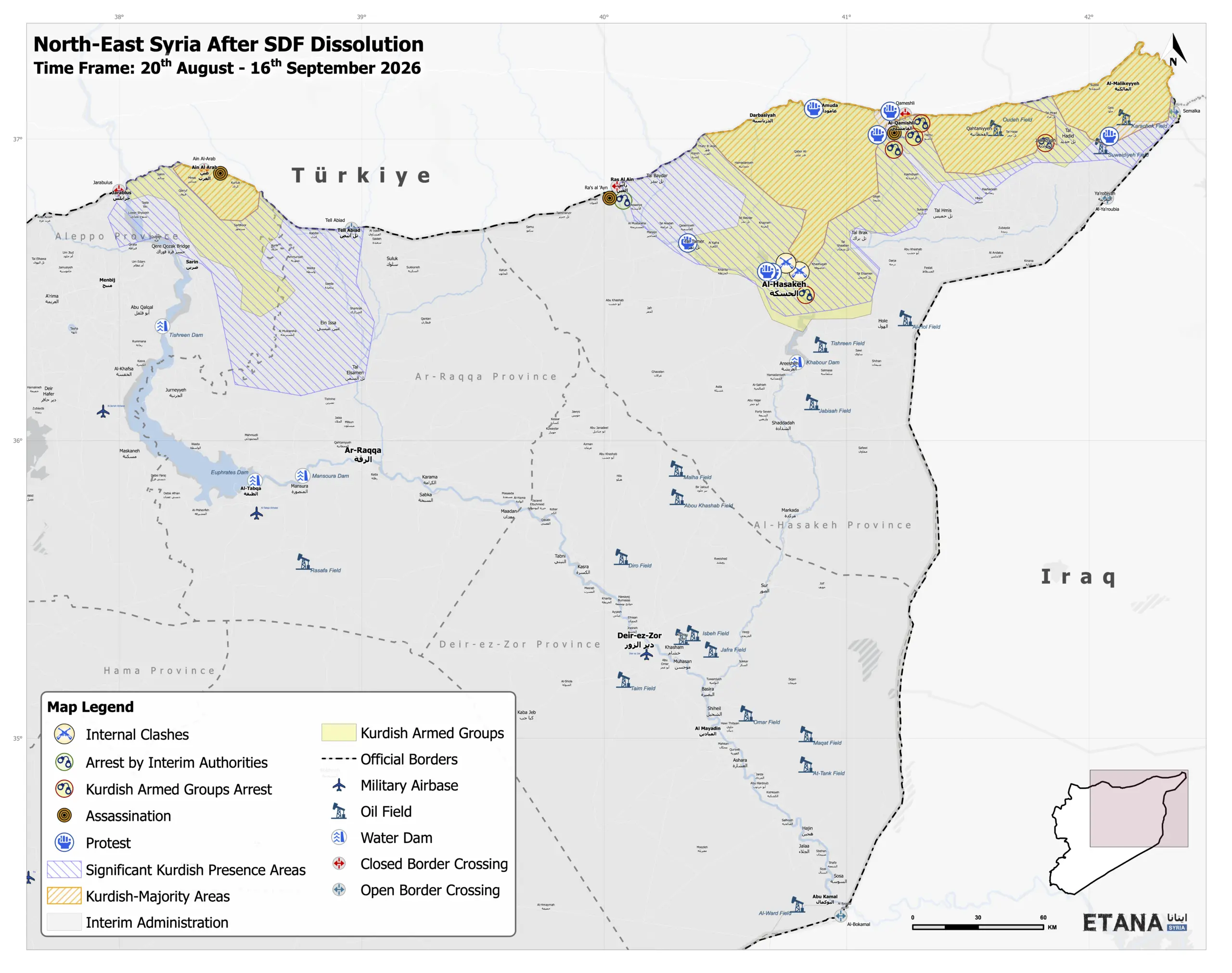
Damascus-SDF Security Integration
In late August, Syrian Democratic Forces (SDF) commander Mazloum Abdi announced the dissolution of the SDF. The declaration raised immediate expectations by both supporters and opponents of the January integration roadmap, for an immediate dismantling of the SDF’s military and security structures and the Self Administration’s political and administrative apparatus. The announcement followed a denial only three days earlier, when Abdi told Kurdish channel Rudaw that he would not dissolve the SDF but rather complete its integration into the Syrian army. This sequencing suggests that Damascus pressed for a formal declaration of dissolution despite acknowledging that implementation would take longer. While Abdi’s announcement represents a major rhetorical milestone in the integration process, Kurdish officials continue to shift the tone and emphasis of messaging on integration based on the situation and audience. However, the shift in rhetoric also highlighted the divergent messaging utilized by Abdi and other Kurdish leaders in recent weeks, as negotiators have attempted to project openness towards government officials while expressing caution to placate Kurdish populations who remain largely skeptical of handing full administrative control over to the Arab and Islamist-dominated interim government in Damascus.
The most consequential—if somewhat less visible—area of merger has been financial rather than administrative: salaries for forces formerly affiliated with the SDF are now disbursed by interim authorities. This has emerged as the decisive factor determining the loyalty of individual fighters and units. This shift has occurred gradually rather than through a single decision, beginning in earnest with the large-scale integration of SDF units under the umbrella of the interim Defense and Interior Ministries. Control of the purse strings has proceeded largely independent of, and further ahead of, the more visible symbolic changes to uniforms and flags used by local units.
Following a meeting of SDF and interim government military commanders responsible for the north-east, government security forces began deploying in the predominantly Arab neighborhoods of Ghuweiran and Al-Aziziyeh, and government personnel are now present within patrols by former SDF operating in those neighborhoods and in the city’s central square. Ghuweiran and Al-Aziziyeh appear to be moving gradually toward full government control under the bilateral agreement.
Ongoing Obstacles to Integration
Despite the effective dissolution of central SDF control over units, the scale of actual military integration remains contested. Hasakeh’s deputy governor stated that integration of SDF brigades into the Syrian army had been completed at 4,500 personnel. However, ETANA’s estimates of integrated personnel are less than half of this. Regardless, the discrepancy between reportedly integrated SDF fighters and the roughly 20,000–25,000 SDF personnel identified by interim authorities for integration remains significant. In practice, the fate of remaining SDF personnel, and the extent to which the process is substantive rather than administrative, remains unclear.
The precise arrangement for female SDF/YPG personnel remains unresolved. On 27th August, a delegation from the Women’s Protection Units (YPG) met with the interim interior minister in Damascus to discuss integrating the force into the Ministry of Interior, but the meeting reportedly failed to produce an agreed solution and remains a major ideological sticking point in the January roadmap. The government maintains that no women’s military college exists through which female fighters could be integrated on the same terms as male personnel—the women’s military college having ceased to exist after the fall of the former regime—leaving only a women’s police academy as a potential integration pathway.
Beyond the security sector, education represents the most consequential pending handover. The interim Ministry of Education decision on Kurdish language education leaves undefined what constitutes an area of “significant” Kurdish population, a threshold with real practical stakes given that Kurds form an overwhelming majority in Amouda, roughly 60% in Al-Darbasiyeh and Al-Malikiyeh, an estimated 25% or less in Hasakeh, under 50% in Qamishli, and a small minority in predominantly Arab towns such as Al-Qahtaniyeh and Al-Jawadiyeh. These ambiguities are likely to complicate implementation of the policy town by town, while potentially stoking fierce tensions in ethnically mixed areas of the north-east.
Political & Economic Developments
Agricultural banks have reopened under government administration in Hasakeh, Qamishli, Amouda, Al-Darbasiyeh and Al-Qahtaniyeh, and have begun to pay farmers the value of their wheat invoices; government post offices have resumed limited functions, exchanging old currency and issuing conduct certificates. Civilian institutional handovers—most notably banks and post offices, but to a lesser extent courts and schools—have proceeded considerably more smoothly than handovers related to the security sector, with long feared language-related concerns largely sidelined in practical implementation of these handovers.
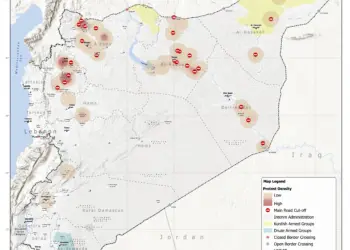
Demonstrations against the interim government’s fuel price increase spread across Hasakeh province in mid-September, touching both government and traditional Kurdish-controlled areas alike. In the government-controlled southern and eastern countryside, protests were recorded in 12 sites in total, concentrated around Markada, Al-Shaddadeh, Al-Arisha and Tal Hamis, with road blockades and the obstruction of oil tankers reported in Markada and Al-Arisha. In nominally Kurdish-controlled areas, protests took the form of organized marches and sit-ins across a wider geographic spread, with 25 protest sites recorded.