Despite the ongoing regional war pitting Israel and the US forces against Iran, and the proliferation of Iranian projectiles and interceptor missiles in south-west Syria’s airspace, the security situation has remained relatively stable: Damascus remains determined to avoid being pulled into the conflict at all costs, projecting calm and vigilance to Tel Aviv with a series of security measures aimed at limiting movements in the south. At the same time, new precedents are being set. Israel has for the first time utilized Syrian territory occupied since December 2024 to attack southern Lebanon, if anything confirming that Israel has both ground and aerial superiority and freedom to operate in south-west Syria. Israel’s warning to local Internal Security forces in Quneitra to stand down in the face of its incursion to Lebanon from the area suggests that Israel will continue to utilize the post-Assad status quo to its regional advantage even after the current conflict in the region comes to a halt.
Regional Conflict
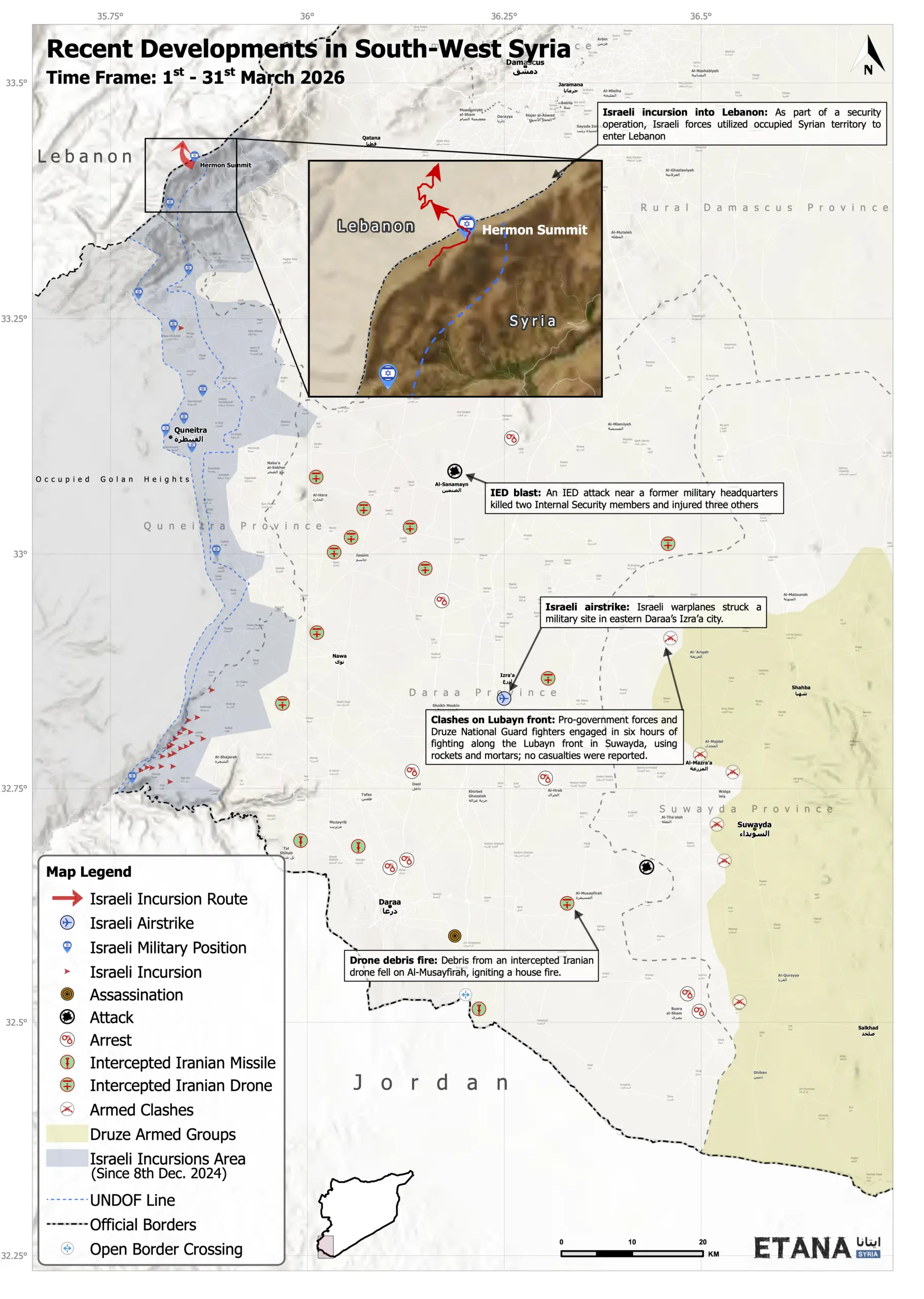
Amidst the ongoing regional conflict between the US, Israel and Iran, south Syria has seen hundreds of projectiles originating from Iran intercepted in Syrian airspace while en route to targets inside the Israeli occupied Golan Heights and Israel proper. This also resulted in a high volume of intercepted drones and missile debris falling across Daraa and Quneitra, particularly during the first week and a half of March. Israeli air defense activity—supported by continuous reconnaissance flights, fighter jets and helicopter interception operations—was recorded on a near-daily basis, with multiple drones downed over or near populated areas including Ba’ath City, Inkhil, Izra’a, Khan Arnabeh and Nawa. In several instances, interceptions resulted in material damage to towns and limited civilian harm, including a house fire in Al-Musayfirah, damage to a residential structure in Jasim and at least one civilian injury near Izra’a.
On 26th March, Israeli forces utilized occupied Syrian territory in far-north Quneitra—close to Jabal al-Sheikh—to enter southern Lebanon. The operation appears to have been limited in scope but demonstrates Israel’s intent on taking advantage of the post-Assad status quo to secure its own interests. Since the fall of the Assad regime in December 2024, Israel has carried out incursions and raids into south Syria, where now authorities in Damascus are restricting local movement to lower the risk of provoking Israel. In January, Israel’s defense minister said forces would remain in the Mount Hermon range “indefinitely.” More recently, Tel Aviv has vowed to occupy large parts of south Lebanon as part of an operation that has displaced thousands.
Interim officials have taken demonstrable steps to avoid spillover and communicate a policy of de-escalation to their counterparts in Tel Aviv. Chief among these actions has been the tight restriction of civilian movement toward border areas, maintaining a network of security checks between Quneitra and Daraa province, preventing entry for non-residents while conducting vehicle inspections. Strict security measures are also being enforced by Internal Security forces in the Yarmouk Basin area of western Daraa. Access to specific towns—including Abidin, Jamleh, Koya and Ma‘ariyeh—is restricted exclusively to local residents. Movement into Quneitra via the Salam Highway, which connects the province to Damascus, is similarly restricted to Quneitra residents and government employees, with routine vehicle searches in place. Speaking in London recently, interim President Ahmad al-Shara’a emphasized that Syria would avoid joining the current regional conflict unless it was directly attacked.
As the Israeli war footprint has expanded into southern Lebanon, thousands of Syrians living and working in the country began a panicked escape towards the border before the escalating bombardment and feared ground campaign by Israeli forces. By the end of March, around 169,911 individuals had entered Syria from Lebanon; the UN International Organization for Migration (IOM) estimates around 95% of them were Syrian. In that same timeframe, ETANA recorded at least 28,000 civilians from south-west Syria returned home from locations in Lebanon.
Nationwide, prices for basic goods have begun to soar in the face of rising petrol costs, while the flood of newly unemployed Syrians fleeing from Lebanon has worsened an already dire employment crisis. Despite an official market conversion rate of 11,750 Syrian pounds to the US dollar, traders have begun selling goods at exchange rates exceeding 16,000 SYP, reflecting renewed fears of currency collapse.
Israeli Strikes & Incursions
In the first attack against Syrian government forces in months, Israeli warplanes launched an early morning strike against military sites in the city of Izra’a on 20th March, resulting in no casualties. The Israeli military justified the strike as a response to what it described as an increase in attacks carried out by interim authorities against residents of Suwayda.
While Israeli ground operations and patrols have continued to infiltrate border areas of Quneitra and western Daraa, these activities have remained relatively stable amid the heightened tensions in the region. Remote areas that have been relatively quiet in recent months—including Ain Dhakar, Al-Asbeh and Mushirfah—also witnessed renewed Israeli activities. Israeli forces are also alleged to have deliberated targeted Syrian journalists reporting from the Quneitra countryside; no injuries were reported. In line with patterns of recent months, Israeli forces conducted limited but repeated artillery barrages targeting the outskirts of Kudnah during the latter half of March, primarily originating from positions around Tal Ahmar al-Gharbi.
Israeli forces continued to impose sustained restrictions on civilian access to agricultural land across western Daraa and parts of Quneitra, preventing farmers from reaching their fields in areas around Abidin, Jamleh, Jubata al-Khashab, Koyah, Kudnah and Ma‘ariyeh. In parallel with Israeli pressure on farmers, the town of Beit Jinn—which has experienced particularly intense Israeli raids—has continued to see approximately 1,000 residents displaced from their homes, most fearful of returning to the town due to threats of further Israeli incursions.
Security Developments
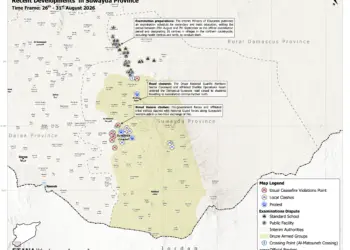
A brief series of clashes and escalation erupted in front-line areas in south-west Suwayda between pro-government forces and members of the Druze National Guard. Lasting approximately six hours, government troops employed rocket launchers and mortar fire, although no casualties were reported on either side. In another incident later in the month, four National Guard members were ambushed by Internal Security units near Bakka in the early hours of 19th March, leading to escalating clashes that drew in additional forces on both sides. Also this month, the UN Syria Commission released a report on the July 2025 attacks in Suwayda, which confirmed that more than 1,700 were killed in the violence, most of them from the Druze community.
Instability in South Syria
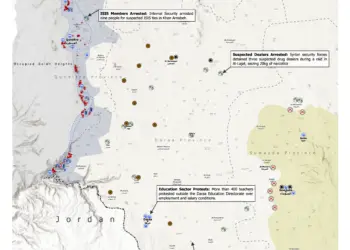
Targeted killings and attempted assassinations remain a persistent feature of instability across south Syria, with incidents recorded in Busra al-Sham, Jassim, Nawa, Tafas and Um al-Mayathin. At least three individuals were killed in these attacks. These were accompanied by numerous attempted assassinations targeting civilians, security personnel and local affiliates, the majority of which resulted in no or limited injuries, underscoring a threat of pervasive daily violence.
Armed violence also remained widespread and varied in form, ranging from targeted attacks on individuals to localized clashes between families and factions. Incidents included attacks on Internal Security personnel and vehicles, RPG and small-arms attacks on homes linked to local figures and inter-communal clashes in areas such as Inkhil and Al-Shumarah that resulted in fatalities and injuries. Additional unrest included civilian injuries from stray gunfire.
The use of explosive devices and remnants of war continued to pose a significant threat, particularly in areas such as Al-Sanamayn and Al-Lajat. An IED attack near former military headquarters killed two Internal Security members and injured three others, while a landmine explosion severely injured a child near Sour. Other incidents, including a grenade attack in Busra al-Sham, caused material damage but no casualties.